


Biography
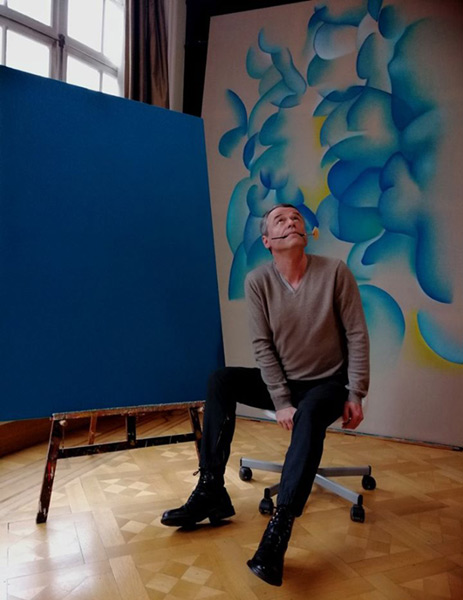
Guillaume Bottazzi is an internationally renowned French visual artist, known for his permanent, site-specific works that redefine the relationship between art, the environment, and human perception, drawing upon fields as diverse as art, poetry, cognitive neuroscience, neurobiology, social psychology, architecture, and design. Born in 1971, Guillaume Bottazzi has been working full-time as a painter for over three decades. He experienced hardship in his early years as he began his career living on the streets. However, he has since achieved remarkable success. He currently works in Europe, Asia, and the United States, among others. He has had his studio in Brussels since 2012. Recognized as a pioneer in the application of the neuroaesthetics movement – a movement that promotes our personal fulfillment – and sometimes cited as the inventor of empirical abstraction in art, he has created almost 200 permanent works of art in public spaces. He has received private and public commissions from museums such as the Mori Art Museum, the Miyanomori International Art Museum—which features his work on every wall of the museum—the Suntory Museum of Art, the National Art Center, Tokyo, and the Tokyo Metropolitan Foundation for History and Culture; from cities and public institutions, such as the City of Tokyo, the Tokyo Metropolitan Government, Hong Kong Government, Paris La Défense, the City of Nice, Brussels ,and from ministries, such as the Ministry of Culture, the Ministry of National Education, and the Ministry of Health. His heritage works have been highly successful and have been sold to numerous publicly traded companies, such as BNP Paribas, Société Générale, Mori Building Co. Ltd., Nexity… and occasionally, with collectors who own properties that allow them to commission perennial artworks, such as in Antwerp, on a replica of the “Katsura Imperial Villa.”
At the age of 17, Guillaume Bottazzi decided to become an artist and make it his sole occupation, a career he has pursued since 1990. Early in 1992, he began creating site-specific works that have been highly successful. His environmental artworks, both indoors and outdoors, stem from a holistic approach that integrates various parameters, particularly contextual ones. As part of his permanent installations, Guillaume Bottazzi collaborates with renowned architects such as Valode & Pistre, Kanji Ueki, ORY.architecture, Leclercq Associés, Tom Sheehan, Coldefy, Antony Béchu, Valero Gadan, Badia Berger, ABC Architectes Jean-Philippe Cabane, and the Atelier d’Architecture Vincent Parreira (AAVP)… Guillaume Bottazzi is also the author of the first educational book that explains modern and contemporary art movements to children aged 7 to 13. This book is designed to support them throughout their academic journey. He began by studying painting in Florence, Italy, and later studied at Baruch College in New York. He considers himself self-taught. In France, after winning a competition, he moved into a studio provided by the DRAC (Regional Directorate for Cultural Affairs). He then left to live and develop his career in New York, where he settled in the 2000s. In New York, his works have been exhibited by the Goldstrom Gallery and the Annex Gallery, an offshoot of White Cube. They are part of the William Whipple and Queen Shorough collections in the United States. The artist has also held exhibitions in Russia at the Novosibirsk National Art Museum and the Moscow National Center for Contemporary Art, as well as in London with BCG (Boston Consulting Group) and Blakers Gallery in Mayair. In 2004, he was an artist-in-residence in Japan and subsequently spent most of his time in the Land of the Rising Sun until 2012. In 2010, through an initiative by the Tokyo Metropolitan Government, the Tokyo Metropolitan Foundation for History and Culture, the Tokyo National Art Center, the Suntory Museum of Art, the City of Tokyo, Mori Building Co., Ltd., and the Mori Art Museum, Guillaume Bottazzi created a monumental abstract work measuring 100 m² in Roppongi, in the heart of Tokyo. In 2011, the Miyanomori International Art Museum, located on a designated historic site in Japan, commissioned him to create the country’s largest painting—which permanently covers all the museum’s walls—and organized an exhibition of his works. Proceeds from this solo exhibition by Guillaume Bottazzi helped support victims of the earthquake and tsunami. This museum houses the largest collection of works by Christo and Jeanne-Claude in Asia and Oceania, as well as some 3,000 photographs by the artist Daido Moriyama. The collection also includes works by artists such as Lucio Fontana, Frank Stella, Robert Rauschenberg, Jasper Johns, and Lee Ufan, and the museum has acquired works by Guillaume Bottazzi. This dual event was supported by the City of Sapporo, Hokkaido Prefecture, the French Institute, and the French Embassy in Japan. In 2012, Mori Building Co., Ltd., following a selection by the Mori Art Museum, commissioned several works from the artist. These works are on display in the new Ark Hills Sengokuyama skyscraper, in the heart of the new Toranomon district in central Tokyo. Since 2004, Guillaume Bottazzi has been represented by the Gallery Itsutsuji. This leading Japanese gallery has helped him establish himself through several art commissions. Mr. Itsutsuji discovered artists such as Yves Klein, and the gallery represents Simon Hantaï, Pierre Soulages, Yayoi Kusama, Ay-o, Pierre Buraglio, François Rouan, Jean-Michel Meurice, and Guillaume Bottazzi. It has also introduced art movements such as the Supports/Surfaces group, which includes Claude Viallat, Louis Cane, Daniel Dezeuze, and Jean-Pierre Pincemin. As a guest artist for Marseille Provence 2013, European Capital of Culture, he created a 36 m² painting. This project was supported by the French Embassy in Belgium. In 2015, he created a 216 m² painting in Paris La Défense, across from D2 Tower. The artist has been collaborating for many years with Galerie Artiscope. This leading gallery broke the auction sales record in France in 2012 and introduced many key figures of the contemporary art scene, including artists from the Arte Povera movement—such as Alighiero Boetti, Giulio Paolini, Giuseppe Penone, and Michelangelo Pistoletto—and the Transavantgarde movement—such as Sandro Chia, Francesco Clemente, Enzo Cucchi, Mimmo Paladino, and also Peter Doig. Guillaume Bottazzi has also received commissions from countries across Europe and China and was a guest at “French May” in Hong Kong in 2016, an event supported by the Consulate General of France in Hong Kong and Macao in partnership with the Leisure and Cultural Department and the government of the Hong Kong Special Administrative Region. His exhibition, held in a 565 m² space, was part of one of Asia’s largest cultural events, which attracted 1.7 million visitors. In Brussels, in collaboration with the European Commission and the City of Brussels, and with the support of the Consulate General of France and the French Embassy in Belgium, he created a 16-meter-tall painting on Place Jourdan in the European Quarter, which is now part of the cultural heritage of Brussels. In 2024, he created a 150 m² polyptych in Paris La Défense, designated by Paris 2024 for the Cultural Olympiad. It is visible from the Grande Arche, extending the line of Richard Serra’s sculpture. This work is part of France’s largest open-air art trail. From Alexander Calder to Joan Miró, César, Daniel Buren, and Takis, the greatest artists have left their mark on the business district. Although he no longer has time to organize exhibitions, the artist invites the public to visit 90 of his artworks in situ during the 2026 European Heritage Days in France.
Guillaume Bottazzi has established his own House of Creation, which contributes to the city’s appeal. It joins a triangle with the Maison Hannon and the Maison Horta, near Place Brugmann. Combining the legacy of the Beaux-Arts style with applied neuroaesthetics, this space takes a radically different approach to conventional practices in our living spaces, as the scenography and site-specific works induce physical, chemical, and functional changes in the central or peripheral nervous system. They help make visitors happier. Within the framework of this achievements, his teams collaborate with artisans, glassmakers, electricians, installers, metalworkers, mosaic artists, and technicians.
If TVB News in Hong Kong first reported in 2016 on a neuroscientific study showing that Guillaume Bottazzi’s works influence our happiness, then, as he continued his exploration, he is now recognized as a pioneer of applied neuroaesthetics. His heritage artworks, located in public spaces, redefine urban landscapes and promote mental balance and collective well-being. As he has received commissions from the Health and Healthcare Sector for ambitious projects, he collaborates with and benefits from enriching exchanges and specialized research with neurologists, neuroscientists, psychologists, and researchers.