



Reflections
AI, an artist? It doesn’t work – here’s why
Guillaume Bottazzi – July 2025
Our sensory organs tell us what we like and what we do not like. Sensory perception refers to the process by which the nervous system detects, organizes and interprets information from the environment via our sensory organs. The insula, the oldest part of the brain, contributes to a wide variety of functions and, in particular, modulates emotional and sensory information (pain, self-awareness, addiction, etc.).
Aesthetic judgement involves very ancient regions of the brain. Eating chocolate that we love, listening to music we enjoy or looking at a work of art we find beautiful all activate the same reward system.
The stages of recognising beauty consist of reward and emotion, sensation and perception, culture and experience.
If you like something, if you find it beautiful, that experience will change your brain and you will learn something.
We activate mirror neurons when we look at a work of art, and if you look at Caravaggio’s painting above, you might feel disgust or fear. And this is because we activate mirror neurons that lead us to have that sort of impression.
According to Oshin Vartanian, an experimental psychologist at the University of Maine in the United States, 85 per cent of judgement stems from the viewer’s personal experience, which explains why they seek to understand the artist’s intention. When people are told that a work has been created by an artist, they like it more. Conversely, when people are told that a work has been created by an AI, they like it less. And this is the case even when they are looking at the very same thing.
Authenticity and forgery alter appreciation, and the same phenomenon applies to just about everything: whether one is looking at a real log fire or a replica; whether one is looking at a replica or an original, and so on.
Many neuroscientists agree on this point: the fake diminishes appreciation, whilst reality alters it.
If AI steals works from the internet to create a patchwork that refutes ‘singularity’ – the quality specific to the individual, to use Gaston Bachelard’s words – as well as creativity and originality, it cannot replace the artist, because our mirror neurons are essential to aesthetic judgement.
The work of art is not ‘Surrealist’
Guillaume Bottazzi – may 2025
The Surrealism of neurobiologist Jean-Pol Tassin
Jean-Pol Tassin, neurobiologist, director of research at Inserm and addictologist, has written L’inconscient aux commandes. In one of his lectures, he explains that “there are two modes in our brain, an analogue mode and a cognitive mode. The cognitive mode is slow, and acts on neuromodulators or neurotransmitters that are dependent on affectivity“.
I note in his representation of the individual that there are no purely objective thoughts in man, since the cognitive mode depends on our affectivity.
“These may be behavioural regulation systems, or those that produce serotonin and dopamine, for example. Our dreams only last a few seconds and it’s a phase that processes our information analogically, even if we find it hard to believe. Our analogue system is a regression. A lot of people talk about dreams and say all kinds of things. Analogue processing is the absorption in a few milliseconds of elements that have an impact on our brain and that will serve as a reference to impact us later. Children, for example, function in an analogue mode, they don’t have a cognitive mode. This means that they can walk without knowing how. We have neurotransmitters such as neuro adrenalin, which wakes us up, serotonin, which protects us, and dopamine, which ultimately decides the hierarchy of structures so that behavioural behaviour is adapted to our behaviour. So dopamine is not just for the reward circuit. Its modulators are extremely small – 500,000 out of 3 billion – and yet these neurotransmitters are responsible for our modulation and regulation, and therefore have an extremely important psychological effect. Depression, for example, is a depletion of the neurons that regulate dopamine and serotonin. Antidepressants allow these neurons to rest and return to a normal state. When we fall asleep, the regulators gradually shut down during REM sleep, so that cognitive processing is no longer possible because the modulators have stopped. And it’s important that they are stopped because they are extremely fragile and need to recover and rest. The brain works all night in analogy, but as they are fragile they cannot stop for more than twenty to thirty minutes. So we wake up an average of a dozen times a night. When the modulators restart, they trigger cognitive functioning and what happens is that you are in a state of analogy, so you have no perception of what is happening and physiologically, there is a modulator reactivation and between the time you wake up and go back to sleep, you may or may not have a dream. This dream will last from 500 milliseconds to one second to three seconds. This dream does not take place during sleep but during micro-awakenings. Sigmund Freud said that dreams are uncensored, but that’s because it doesn’t have time for censorship. Dream interpretation is linked to the detection of dream symbols. For him, the artist translates his analogical dreams into cognitive terms, and the artist who touches you, touches you analogically, it’s not cognitive. The emotion you get from a work of art comes from the unconscious, from within. The dream comes from real sensations and emotions.”
I note that for him the analogue mode is a mode linked to sensations and emotions.
“Since 1960, the neurophysiologist Michel Jouvet had identified REM sleep, a part of sleep in which we sleep but our eyes move and as they move he considered that we dream during this period and since many people believe it. In reality, you can’t dream during REM sleep because the neuroregulators are inactive. You can have a dream during the micro-awakening that follows”.
To sum up, from the point of view of neurobiologist Jean-Pol Tassin, the analogy is our unconscious. It reveals our affect and our links to a specific experienced environment. It shows the being without filters and without limits and this implies that for him the work of art is a surrealist act that reveals our deepest truth named the unconscious.
The work of art is not surrealist
I had a dream last night that I remember; it intertwined my experiences and my feelings, it exacerbated my fears, and it was mixed with real situations as described by Jean-Pol Tassin.
I’ve never dreamt abstractly, and I don’t paint figurative works. There is no sleepiness, no dreaminess, no aesthetic lightness in my dreams, and precisely not the kind I find in my creations. There is no link with an approach to form, an atmospheric quality to the images or an aesthetic interpretation. There are no dreams that go in the direction of my imagination, and I feel more inspired by observing a landscape when my dreams don’t inspire me.
Gaston Bachelard‘s imaginary world is prior to thought and feeling; it is an imaginary world that is reconstructed and not something that is suffered. This imagination allows us to appropriate spaces, to find ourselves in tune with our history, to recreate ourselves, confronted with the unreality of images, to rebuild and renew ourselves. This imaginary world takes shape while we are awake. It is the fruit of conscious and unconscious reconstruction.
In my opinion, the imaginary is beautiful and comes from an awakened creative act. It is an act of sublimation as described by Sigmund Freud. It’s the transformation of energies that come from outside and inside, it’s the reconstruction of an integrated being that’s trying to surpass itself.
‘Everyone has thought that sleep is of the brain, by the brain and for the brain. We neglect the fact that we are not brains, we are mechanisms, we are integrated, everything we do is integrated with everything else’ explains neuroscientist Paul Shaw from Washington University in St Louis.
Imagination is a mental thing, the fruit of reconstruction, a reinvented universe that helps us to live better and to elevate ourselves. It stimulates us through sensory experiences and creates aesthetic and cognitive activity. An experiment on mice showed that by enriching their environments and encouraging sensory stimulation, their cognitive capacity increased by four per cent in a fortnight. The need to feed our imaginations rather than our dreams seems clear-cut.
Our differences or prejudices
Guillaume Bottazzi – April 2025
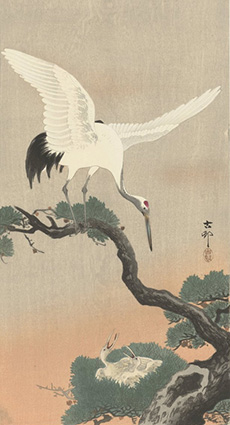
Japanese crane on a pine branch by Ohara Koson, 1900-30
Japanese woodblock print in colour
White is often used as an example to explain how a color can be received differently; it is the color of the dead in China and Japan and the color of wedding dresses in Western and Christian cultures. So, it’s true that these contextual and cultural factors come into play in our prism, but counterexamples don’t rule out the biology of our systems. In Japan, white can also be received differently. For example, walls that are frequently white are much appreciated and there is a fascination with white cranes. In the Land of the Rising Sun, the Japanese crane symbolizes peace, luck and longevity. This sacred animal is also associated with fidelity and wisdom. Many beliefs and superstitions stem from this bird of good fortune known as Tsuru. It is said that a crane can live for 1,000 years, and that a pair of cranes will ensure a happy marriage.
A breath of life
Guillaume Bottazzi – September 2024
If art insatiably nourishes our exchanges, and if the concept of art evolves with time and culture, then it is essential to question not art itself, but its effects. In this reversed light, the question of art becomes decidedly clearer, precisely because we know it demands mental engagement. Our interpretation is filtered through a lens that is closely tied to the moment in which we observe a piece, the place it occupies, the cultural symbolism of that location, the quality of those around us, the observer’s environment, and their personal experiences1. Neuroscientists seem broadly to agree on this point: art requires mental processing, and it compels us to reflect on our own conception of it. In this sense, the question of art is partially answered, since this polymorphous and reflective matter is alive and constantly shifting in the eyes of the beholder.
Gaston Bachelard asserts that space does not exist in itself, but is a product of reconstruction, adding that the intrinsic quality of a work is significant. He is right. I, too, am passionate about integrating art into people’s daily lives, especially in busy public spaces; these works become aesthetic reference points for those who frequent them, woven into each person’s lived experience. Over time, my in-situ creations become associated with memories of moments lived. They invite a form of reconstruction, because our perception is always a process of re-creation: we do not perceive the world around us as it truly is. Our perception is not a copy-and-paste mechanism: it is a reconstruction, a holistic experience. Though Emmanuel Kant addressed this point in The Critique of Pure Reason, he did not possess the tools we have today for understanding the interaction between our cognitive mechanisms and artistic experiences. There is a fruitful dialogue emerging between phenomenology and neuroscience, with many points of intersection. “Thought does not precede action, nor does action precede thought: action contains all thought,” declares neurophysiologist Alain Berthoz. In saying this, he counters Kant’s idea that art can be purely cerebral, and challenges the analytical philosophy of Ludwig Wittgenstein, which has allowed a small cultural oligarchy to preserve its dominance. That philosophy sets itself up as the sole gatekeeper of art, where only those who decipher its codes – ‘connoisseurs’– are granted access. Denying the sensory experience between artwork and audience, as analytical philosophy tends to do, obstructs art’s power to make us evolve. Art is something sensitive, something that is, and which appeals to everyone’s sensibilities. It is through our senses, through action and immersion, that we truly experience art. I recently read an article (the author shall remain nameless) which claimed that “the artist does not simply draw shapes, but his drawings are genuine committed messages.” If art is supposed to help us evolve, then this kind of confusion is troubling. First of all, artists are not moral exemplars, and we must distinguish between the individual and their work. Moreover, socially engaged art restricts the possibilities of art itself: art is a breath of life, while socially engaged art often verges on a cerebral suffocation, frequently acting as a vessel for covert propaganda – as in France – or even overt propaganda. Our societies are in turmoil; we must break free of propagandistic constraints and preserve the artist’s freedom from imposed social roles. For his part, Pierre Bourdieu said that “to get people to talk about their tastes, you have to get them to talk about what they dislike.” For him, art expresses our position in the social world, and he rejects the notion of immutable, natural beauty. According to Bourdieu, our tastes reveal more about us than our stated opinions, and the museum functions as a sacred space, akin to a church, a place of distinction separating those who may enter from those who may not. He argues that science can explain the structure of colours, but not the pleasure they give. Here, I believe he errs: we can now observe how colours affect us, track neural responses, and identify the areas of the brain activated when we look at works of art. Neurobiologist Semir Zeki found, for example, that Lucian Freud’s paintings tend to activate the amygdala – linked to fear – in most viewers. Humans need to project, to dream. Artists –who are sadly becoming an endangered species – are vital social connectors, as shown by the poet in Fellini’s Satyricon. Yet, many European institutions are mired in guilt and outdated complexes, paying a high price for it. Mathematician and Fields Medallist Cédric Villani remarked during a television appearance that, while the standard of mathematicians in Europe is high, it often goes unrecognised. Even Alan Turing, a scientific giant, was undervalued to the extent that he was advised to study under American mathematicians! Today, few artists can afford to work full-time, with most surviving on state support. To serve their role truly in society, they must free themselves from this dependency. For his part, Pierre Bourdieu said that “to get people to talk about their tastes, you have to get them to talk about what they dislike.” For him, art expresses our position in the social world, and he rejects the notion of immutable, natural beauty. According to Bourdieu, our tastes reveal more about us than our stated opinions, and the museum functions as a sacred space, akin to a church, a place of distinction separating those who may enter from those who may not. He argues that science can explain the structure of colours, but not the pleasure they give. Here, I believe he errs: we can now observe how colours affect us, track neural responses, and identify the areas of the brain activated when we look at works of art. Neurobiologist Semir Zeki found, for example, that Lucian Freud’s paintings tend to activate the amygdala – linked to fear – in most viewers. Humans need to project, to dream. Artists –who are sadly becoming an endangered species – are vital social connectors, as shown by the poet in Fellini’s Satyricon. Yet, many European institutions are mired in guilt and outdated complexes, paying a high price for it. Mathematician and Fields Medallist Cédric Villani remarked during a television appearance that, while the standard of mathematicians in Europe is high, it often goes unrecognised. Even Alan Turing, a scientific giant, was undervalued to the extent that he was advised to study under American mathematicians! Today, few artists can afford to work full-time, with most surviving on state support. To serve their role truly in society, they must free themselves from this dependency 2.
The implications are profound, and they open new perspectives for art. This concern has become a global issue, and in 2019 the World Health Organisation confirmed that art can significantly benefit both our mental and physical health. It can improve behaviour, ease psychological strain, reduce feelings of isolation, and offer comfort, happiness, and even elegance. Eric Kandel, winner of the 2000 Nobel Prize in Physiology or Medicine, has shown that abstract art stimulates the formation of more new neurons than figurative art, helping us step back and view the world differently. Henri Matisse was right to claim that “the duty of the painter is to give what photography does not.” If we truly considered human cognition in the creation of art, we could allow art to flourish in its mission to serve the greater good. When we look at a painting, we follow its lines, seeking intersections; these aid our understanding. In this sense, lines are fundamental; the audience must interact with the work. If the viewer does not appreciate the piece, cognitive activity is significantly diminished; a phenomenon neuroscientist Oliver Sacks referred to as a ‘missed encounter’.
Yet, Kandel also shows that the dissolution of lines is essential to provoke cognitive activity and the creation of new neurons. He cites the diffuse contours of Mark Rothko’s painting as a prime example. In my own practice, I work with gradients that open up space towards the invisible. The supporting medium I use creates a sense of infinity, expanding beyond the frame and thereby enhancing the artwork’s impact. It invites the viewer to reimagine what they see, triggering neural activity. Artists should strive not to impose themselves, but rather to disappear, so that the viewer may find freedom within the work and unlock its full potential for his own benefit. Neuroscientist Vilayanur S. Ramachandran’s research on seagulls seems particularly relevant: he demonstrates how our appetite for art is linked to form synthesis. This could explain the appeal of Aristide Maillol’s sculptures. Art reduces our sense of loneliness and isolation; we do not view a work of art merely as an object, but as though it were a person. It activates mirror neurons, which are the same ones triggered when we gaze at someone we truly love. This suggests that we should accompany people who suffer from loneliness, people who are going through difficult times – such as those in palliative care, for example – with works of art, or that we should install art in centres for the elderly. The powers of art are immense, and we can measure their effects through our sensory experience. The World Health Organisation itself confirms that art can reduce social tensions and contribute to mental health, so what are we waiting for?
Art must inspire us and nourish our imagination. Only through freedom can artists fulfil their role and offer society that glimmer of hope that slips through the net. Art is multifaceted; it adapts to our needs, and we, in turn, feed on its lifeblood. It is a vital force, capable of supporting our evolution, our recreation, and our individual needs. As the philosopher Marc-Alain Ouaknin has said, the richness of a work of art necessarily implies a polysemic, open form of expression.
1 I recommend reading the book Skin in the Game, by Nassim Nicholas Taleb.
2 Cf. Helmut Leder and Marcos Nadal, « Ten years of a model of aesthetic appreciation and aesthetic judgments », British Journal of Psychology, 2014.
Words mislead us
Guillaume Bottazzi – September 2023
Words mislead us, or to be more precise, they lead us to misunderstand our mechanisms.
“Words distance us from things,” said the philosopher Henri Bergson. Thus words mislead us and deny us an understanding of ourselves. They are not the product of reality, but are created by man; they are the fruit of a prediction or a projection. Words are fiction.
For example, we have invented words like ‘desire’, ‘love’ and ‘beautiful’. However, the neurobiologist Semir Zeki clearly explains that in his experience of recognising beauty, an observer borrows from areas of his brain that are the same. If our cerebral system does not distinguish between these experiences, it is because they are the same; in other words, desire, love or beauty have the same cerebral implications.
For the sociologist Pierre Bourdieu, science cannot explain the pleasure we derive from colours, but only their structures. He was wrong, because neuroaesthetics now makes it possible to understand how and why colours affect the viewer.
Our knowledge of this mechanism is bringing about a profound change in art which, long awaited by an artistic community that is not renewing itself, will enable us in the future to look at a work for what it produces and not for what it is.
I dream of a world that is no longer a brake on art, because art today is subject to the strategic implications of policies that reduce its scope.
I dream of an art that does not divide the world so that some people can claim to belong to a dominant or dominated social category.
I dream of a world where art is presented in hospitals, in health organisations and in our daily lives, so that everyone can benefit from it…
For example, we now know that when we look at a work of art that we find beautiful, it activates mirror zones that are the same as those activated when we look at a person we really like. In other words, surrounding yourself with works of art that you love helps to alleviate feelings of loneliness. This means that art is not something trivial, that it can be a factor in psychological balance.
Art is therefore a powerful vehicle for building, recreating and rediscovering ourselves: art must reconnect with beauty. This beauty does not find its essence in itself, but through the effects it has on people. The aim is to create a better world that promotes peace and love, but also generates pleasure, helps us to develop our cognitive capacities and our ability to cope with the difficulties of life, to step back from things, to strengthen ourselves, to balance our psyche, to become stronger, more creative, more elegant, more virtuous, more sociable, more likeable, more loving…
Art reconnects with beauty – more
Guillaume Bottazzi – May 2023
Art encourages love and peace
For the record…
Beauty and art were brutally separated by Marcel Duchamp with his urinal (see Fountain). Not all artistic work, however interesting, necessarily relates to the experience of beauty.
We have a filter that separates the ugly from the beautiful, with the information sent to different regions of the brain.
Neurobiologist Semir Zeki states that beauty is desire and love, and that there is a mirror association with beauty. When people look at a person or object they desire, they use the same pathway as for beauty. So there is a common area of activity localised in the medial orbitofrontal cortex; these areas are activated when one experiences beauty, but they are also sometimes active when a person looks at individuals of whom they are really fond.
Contextual deviations in a society in crisis
Today, deviations and confusions are to be avoided. Amalgamations have become common, and these shortcuts reflect the dysfunction of our societies.
– I note that beauty is sometimes perceived by some people as being reserved for the rich, and this makes art a mark of division between social categories. Studies of a population living in poor ANRU1 zones show that disadvantaged social categories want to break away from this rule, because they do not want to be associated with a social marker that presents them as belonging to a dominated class. The vast majority of people living in these areas want the same benefits as the better-off classes.
– Some of us feel that if there is an 80% of women in artists’ works, and beautiful women at that, this is the mark of a reduction in the status of women, with them being reduced to the role of women as objects. People sometimes do not know how a human being functions. All neuroscientists agree on this, but I would like to quote Anjan Chatterjee who explains in his talk “How your brain decides what is beautiful”, that a person who is considered beautiful is associated with a person who has qualities and values. For example, Sandro Botticelli’s Birth of Venus is an allegory of female beauty and purity. The recognition of beauty leads us to see the person as more intelligent, as having more values and common sense, as being deeper and more perfect…
In our appraisal, they will have more inner qualities than others.
Art must contribute to a better world
The people involved in some way in the art world represent 2% of the population. These players sometimes consider beauty to be an embellishment that hides the substance: it can be considered superficial, while bad taste, kitsch, is a claim that has remained very present in the art world. The art world has banned the word ‘beautiful’, but it has remained in the dictionary and in the collective consciousness. The study Art, Aesthetics and the Brain by the neuroscientists Helmut Leder and Marcos Nadal mentions that people who observe works of art associate them with their reference to beauty. Contrary to what Kasimir Malevich thought when he painted his Black square on a white background, the work is not the subject, but the subject is the effect it produces in the viewer.
In conclusion, Semi Zeki explains that beauty activates the same areas as love and desire, and that our brain couples these together. Art therefore inherits a primary mission for humanity, which is to promote love and peace.
Artists must make the world more beautiful to help spread love and joy, but also to strengthen our will to live and our ability to survive events.
1 ANRU: Agence nationale pour la rénovation urbaine (National Agency for Urban Renewal), which has the general goal of backing comprehensive urban projects to transform disadvantaged neighbourhoods in depth.
Space-time in art encourages the notion of timelessness
Guillaume Bottazzi – March 2023
What if we were to reconcile quantum physics or the special theory of relativity with art? Our notions of space and time imply fundamental changes in the relevance of artistic proposals.
In quantum physics, time does not exist, but the idea of duration does. All durations are different, and astrophysics, particle physics, cosmic rays, space navigation, space telecommunications and GPS or even the Shinkansen prove this. If, for example, clocks are installed on each floor of a building, they will not show the same time to within a few hundredths of a second; but of course, this does not prevent us from organising ourselves on a daily basis, since the differences will be minimal.
The philosopher François Dagognet proposes to “draw from the outside to nourish the inside“, and this must be applied to art in order to stop relying on received ideas to establish aesthetic orientations. The astrophysicist Aurélien Barrau, in his lecture “Beyond general relativity”, explains that Einstein understood that there is no opposition between container and content, contrary to what Isaac Newton thought. This roadmap implies from the outset that the arts cannot decently deny appearance without risking a form of obscurantism. Physics tells us that “appearance does not hide the essence, but reveals it: it is the essence“, as Jean-Paul Sartre1 put it, as did Sonia Delaunay in her work.
What are we in this scheme?
Space-time is a dynamic quantity, and this means that if you want to know who you are, you are not a given moment, but rather a curve. Being is to be read in terms of duration; it is a story. This would no doubt please Jacques Derrida, for whom everything is writing.
Immanuel Kant was wrong in this respect when he wrote that “time is not a concept, because it is not the simple representation of a sign common to a multitude, but contains in itself a multitude of representations, and in this sense it is a universal of a particular kind […] an infinite magnitude“2.
Marcel Proust, on the other hand, adopted time as an expandable phenomenon; for him, past and present are linked. In In search of lost time, he evokes his emotional memories, which interfere with the present.
Being is a line of the universe; it is made up of a multitude of points. There is no point in avoiding the past, the present and the future if we want to get closer to the truth. Art must be timeless and create phenomena that are transformed in the imagination of the viewer.
The implications of art are important
Which works reconcile the implications of quantum physics or special relativity with art? Quantum physics threatens time, and therefore modern art, engaged art, artivism and history painting in particular. All these movements ignore timelessness. Only timeless works bring coherence to this reconciliation.
So, if we reconcile time between art and the special theory of relativity, timelessness is the order of the day, as in the work of the painter Henri Fantin-Latour, who did not seek to be in step with his time. His art is not based on current events, but on a timeless approach.
Our living spaces
In quantum physics, space is not clearly defined: it is the result of a projection, and it is by revealing our imagination that we can create living spaces3.
1 Jean-Paul Sartre, Being and nothingness.
2 Martin Heidegger, Phenomenological Interpretation of Kant’s Critique of Pure Reason.
3 Guillaume Bottazzi, Guillaume Bottazzi et la joie d’habiter.
The limits of neuro-aesthetics
Guillaume Bottazzi – January 2023
A tour through the history of pink
I have been looking at the research undertaken by Michel Pastoureau, historian of colour: his work illustrates the history of colour in the Middle Ages or, rather, how colour has been experienced by our societies.
“For art historians, there is this notion that line takes precedence over colour, following on from Plato and Aristotle for whom colour seemed superfluous. At the end of the Middle Ages, this idea intensified until the seventeenth century, was revived in the eighteenth century and returned in the nineteenth, notably with Delacroix.”
Let’s ask this question from the point of view of fashion, for example: Why is pink for girls?1
According to Emmanuelle Berthiaud, a historian specialising in women’s history, “a few hundred years ago, pink was attributed more to men; it was considered a variant of red, marking masculinity par excellence. Since ancient times, it has symbolised power and authority. The word ‘pink’ did not exist in Greek or Latin. Instead, it was called ‘crimson’. Pink was worn during the Renaissance; it was a fashion for the elite and for men. In France, at the time of the Enlightenment, Madame de Pompadour made pink fashionable, but there was nothing specifically female about it.
From the twelfth century onwards, blue was a colour increasingly attributed to women, in reference to the blue cloak of the Virgin Mary. Children were most often dressed in white, which evokes purity and innocence. The Protestant Reformation influenced fashion and brought about changes by favouring black, brown, grey and blue. Blue was increasingly associated with power. Women, including peasant women, often dressed in red. Goethe explains that ‘the female sex in its youth is attached to pink and sea-green’. In the nineteenth century, coloured clothing became more ‘democratic’; red and blue were also used for children, in softer tones. In English-speaking countries, the use of blue for boys and pink for girls began in the mid-nineteenth century for the elite, then intensified with the development of marketing. At the end of the Second World War, pink became an established part of advertising for housewives. From 1980 onwards, our consumer society encouraged the differentiation between boys and girls, so that the older sister or brother would not pass on her things or toys to her younger brother or sister.”
For the historian Michel Pastoureau, colour is first and foremost an abstract notion. Contrary to the neuro-aesthetic approach, according to him, it is society that makes colour: it is cultural. Colour is resistant to analysis and synthesis.
In his opinion, yellow is a sunny colour associated with joy. In the Middle Ages, yellow was considered a benevolent colour; but from the end of that period, everything became brown, and yellow was associated with illness, with the colour of urine. Later, Vermeer used yellow, and the Impressionists brought this colour back into the limelight for good; the Fauvist painters highlighted yellow again, through the work of artists such as Henri Matisse, André Derain, Maurice de Vlaminck, Vincent Van Gogh. Indeed, it was the painters who rehabilitated yellow.
Pastoureau also says that the more humble social classes in the eighteenth century wore bold colours, while the elites distinguished themselves with half-tone colours. According to him, too much colour kills colour. He mentions that urban planners have sought to place large areas of bright colours in the urban fabric, and that the population asked them to remove this social marker.
From art history to neuroscience
While the history of colour is a fascinating subject, the fact remains that the historian’s approach is based on social and cultural issues, not biological ones, unlike neuroaesthetics.
Neuroaesthetics focuses on the human system as biological identity: this implies that the power of neuroaesthetics must be relativised, since cultural parameters are a part of aesthetic judgement. It also implies that the historian’s point of view and that of cognitive psychology complement each other and provide different kinds of information.
In cognitive psychology, the Western visitor to a museum such as the Louvre is faced with works that represent his idea of beauty: in other words, what is recognised as such by his own culture. The works he sees become his reference of beauty. According to the anthropologist Marcel Mauss, a work of art is what is recognised as such by a group of people.
The historian, on the other hand, has skills that belong to the past; the profession of art historian was created in order to categorise works according to ethnic groups and periods, whereas the neuroscientist focuses his research on living beings. The measurement tools at his disposal have only been in existence for a few decades. For example, this implies that psychologically interpreting the red cloak in Little Red Riding Hood would not seem a worthwhile exercise, because the story is from another era with other codes.
Does neuroaesthetics transcend cultures?
Nobel Prizewinner for medicine Eric Kandel recommends the diffuse to force cognitive activity. Contrary to what Plato thought, for neuroscience, colour takes precedence over line; more precisely, it is light that takes precedence, colour being corollary to the wavelengths that are deposited on photons.
The founders of neuro-aesthetics, Semir Zeki and Vilayanur S. Ramachandran, base their experiments on patients from different cultures and social backgrounds: their ambition is to overcome divisions and provide universal knowledge.
When I present my work in the West, I consciously and unconsciously incorporate subtleties from my culture. What about when I present my creations to a distant culture?
I work in Asia, and I know Japan fairly well, for example; but not well enough to read all the subtleties, since I was not born in the Land of the Rising Sun. In this case, my aesthetic proposal brings our cultures closer together, and the biological effects should be similar; therefore, this does not exclude the phenomena created in the observer. Thus, the strangeness and break with preconceived ideas are more favourable, but so are misreadings. For example, while white is associated with peace in the West, it is during the Japanese funeral ceremony that relatives are traditionally dressed in white, as this is the colour of mourning.
Does neuroaesthetics transcend time?
Another phenomenon seems interesting to note: when a Westerner observes, for example, a painting by Botticelli, this artist is part of his cultural heritage. However, the work observed comes from another era: an era that the viewer did not live through, and this implies that what the viewer projects is something that is not the same as what the contemporaries of the painting projected. In this case, Botticelli’s work is transformed; it is reincarnated through the viewer’s own elaboration, living in another context. Botticelli’s painting is no longer the same, but is malleable and is transformed as a function of our history. The very nature of art is to become what we make of it; it depends on the way we are pervaded by the work.
If we know the aesthetic effects produced in our contemporaries, the past belongs to historians, who strive to understand ancient civilisations. This does not exclude the appreciation of a work of art from the past, although it does not project the same as when it was created. The work of art is the result of a reconstruction.
The historian gives us an ethnological view of the world of dead people, while neuroaesthetics observes the living.
1 https://www.radiofrance.fr/franceculture/pourquoi-le-rose-c-est-pour-les-filles-9568791
Summary
Guillaume Bottazzi – August 2022
I am writing today to offer a summary of several articles, for those readers who may have not have understood – or sometimes oversimplified – some of the previous publications dealing with art1. All the following statements have been proven and none of them are in any way disputed.
We have seen in earlier articles that the artist elaborates his creation, notably with the help of a warming up of his senses, which will enable the inducement of the observer of that work to live a sensorial experience.
We have also seen in previous articles that man is an integrated being who does not exist in himself. You will then understand why the object of a work is not limited to the artist or his interiority: the work is not its physical composition, but the phenomena it creates, namely the effects produced on the observer. The experience proposed belongs to the viewer and is different for each of us. The viewer will elaborate what he or she feels according to his or her experience, needs, sensitivity, environment, social surroundings, the place where the work is presented, etc.; and since our personal experience influences our aesthetic taste, it is important to surround ourselves with works of art in our daily lives.
This sensory experience will strengthen the identity of the observer, but also his or her desire or capacity to live. Moreover, it strengthens one’s own history, one’s backbone; it facilitates one’s own re-creation, one’s ability to distance oneself from things, to feel better or well. My works are also designed to ‘dislodge’ the subject’s neurons, which are in comfort zones; they modulate neurons, which is to say that they create new ones.
In short, my works not only make the viewer more intelligent, but also happier and strengthen his or her capacity to live.
According to the World Health Organisation, works of art make us more elegant and sociable. They improve our physical, behavioural, psychological and social health by reducing feelings of loneliness: when we look at a work of art, our mirror neurons are activated as if we were not looking at an object, but at a person we love. Finally, they allow us to appropriate living spaces, because spaces do not exist in themselves.
While the sociologist Pierre Bourdieu said that American abstract expressionism is considered to be in good taste for all the dominant social classes,2 it has also been shown that this movement reduces the scope of a work of art, because here, the work is only linked to the artist, to the insula, to the artist’s interiority, to his feelings and self-consciousness. We have seen that the insula is a part of the self, but that the being is more complex.
What warms up the senses and inspiration of an artist is a correlation between the outside and the inside. Art is peripheral to the artist and his senses refer to what is outside him: his perceptions.
Moreover, in the collective consciousness art is the representation of the beautiful, and the beautiful makes us feel better. The recognition of the beautiful activates the same areas as the feeling of love; it produces a richer activity in the observer than if the work were to act only on the amygdala, for example.
Vassily Kandinsky wrote that art elevates people. For me, it carries the world, despite what we do with it today.
1 Earlier essays:
Art enhances the viewer’s cognitive acuity: “A system designed to adapt to its environment”, Guillaume Bottazzi, 2022
Art reconnects with beauty, Guillaume Bottazzi, 2021
Priorities in art, neuro-aesthetics and its orientations, Guillaume Bottazzi, 2021
The Neuroaesthetics of Guillaume Bottazzi, Guillaume Bottazzi, 2021
Guillaume Bottazzi and the joy of inhabiting, the in situ works of Guillaume Bottazzi reveal new environmental paradigms, Guillaume Bottazzi, 2020
Senses and art, Guillaume Bottazzi, 2020
Supermodern abstraction, Guillaume Bottazzi, 2020
Brain and art, Guillaume Bottazzi, 2016
2 Pierre Bourdieu – La Distinction. Critique sociale du jugement, 1979
Art enhances the viewer’s cognitive acuity: “A system designed to adapt to its environment”
Guillaume Bottazzi – June 2022
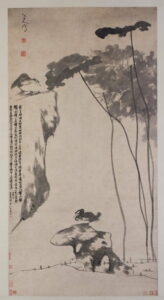
Zhu Da, Lotus flower and ducks, circa 1696, vertical scroll, ink on paper, 95.8 × 185 cm, Freer Gallery of Art. Washington
Man is an integrated mechanism
We used to think that sleep was a neurobiological phenomenon and that its purpose and structure were located in the brain.
“Everyone thought that sleep is of the brain, by the brain and for the brain. We overlook the fact that we are not brains: we are mechanisms, we are integrated. Everything we do is integrated with everything else,” explains neuroscientist Paul Shaw of Washington University in St. Louis.
The first cracks in this brain-centric view began to appear when Swiss scientist Irene Tobler noticed that cockroaches sleep unconsciously. Recently, a new discovery has completely changed the narrative. We have learned that even the simplest creatures, organisms with very little brain, also sleep. For example, a study was conducted using a hydra, one of the simplest forms of animal life. Instead of a brain, the hydra has nerve networks, the most basic nervous systems in nature. In 2021, a group of Japanese scientists demonstrated that hydras sleep. These tiny freshwater organisms are living proof that sleep evolved before the brain. More and more scientists are really looking at peripheral tissues and asking how the body can impact the brain, and how the brain can impact the body, specifically with regard to sleep regulation.
In his research, neuroscientist Paul Shaw hypothesises that there are situations that the brain cannot regulate alone; in association with the damage that has occurred, sleep can reduce the activation energy for the brain’s circuits to begin to find a solution. The idea is that when we sleep, we consume less energy. The energy we use then is used in a different way. We support functions that we could not support if we were awake. Research into the hydra offers the first of a growing body of evidence that sleep first evolved to regulate metabolism and improve a repairing function, and only later took on brain-related functions. Sleep and metabolism are closely related.
To contextualise with art: if human mechanisms build themselves in relation to their surroundings, this implies that the intrinsic nature of a thing or being is not limited to an individual. The human being is an integrated organism constituted by its environment, its microbiota and peripheral elements. The artist reveals not only his identity, but also his relationship to the elements, which are themselves constitutive of his own construction. He reveals energies that allow us to be more in tune with the world around us. The artist enables the observer to have a more harmonious relationship with things, in a global manner. This infers that the subject is not the artist, but the effects of the work on the observer*, which can facilitate his or her ability to adapt to the environment. The work of art is linked to the inside and the outside, and the mind is inseparable from the body.
* Physicist Jean-Claude Picard explains that when we look at a work of art, we separate the lines, depth, shape, colour and movement… All these factors are processed in different locations in our brain. The brain will reconstitute them in phases, in a synchronised synthesis. For hearing, there is the pitch, the rhythm of the sounds, the timbre. The many factors are analysed in different areas of the brain, are then reconstituted and so bring us pleasure or sometimes displeasure.
The human brain is unique because our system is designed to adapt to its environment
Albert Einstein’s brain weighed only 1.2 kg and that of Nobel Prize winner Anatole France 1.1 kg. That’s not a great deal but it is not the size of the brain that makes it creative. Scientist Suzana Herculano-Houzel has developed a new technology to count the number of nerves in the brain. What she measures is the number of processors, of which there are many: around 100 billion.
Recently, she measured the number of nerves in the brain of an African elephant as the elephant’s brain is huge, bigger than a human brain. Indeed, the elephant has a brain three times the size of that of a human, but most of the networks are at the back of the brain. The number of nerves in the cortex of the human brain is larger and wider than in any other being. The difference is that the human brain is very connected. This means that it has the ability to move information from one area to another very easily, which is essential for creativity.
Neuroscientist Idan Segev of the Hebrew University of Jerusalem gives an example*: “a glass involves the concept of the glass, its shape which is associated with vision, taste, touch; so when we integrate the concept of a glass, we have to elaborate and call into action many modules or modalities, which interfere with different regions located in this context in the back of the brain, in the front and in the side, and these regions have to be connected to handle different types of information, to generate language, for example.” We have 3 to 4 km of connections which represents 100 million connections, and locally we have many circuits. We develop our brain more slowly than other animals. Thirty thousand networks are activated locally. The number of synapses and connections decide the dynamics of our system: not only the connections between the different regions, but also the connections within each region.
This system is designed to adapt to its environment, and this implies that artistic expression does not limit itself merely to revealing the ‘essence’ of its creator or his life, but enables the observer to be more in tune with things in a global manner.
* In the context of the conference “The brain and artistic creation”.

Yokoyama Taikan, Gunjo Fuji, circa 1917, Shizuoka Prefectural Museum of Art
The effects of colour on humans
Guillaume Bottazzi – January 2022
Colour phenomena in humans
Colour has always fascinated mankind, but new knowledge in neuroscience and cognitive psychology is now providing more insight into its effects. Further studies are nevertheless needed to understand fully our visual system and our relationship to colour. Colours are electromagnetic waves with light being captured by the eyes using waves of different lengths produced by particles that are reflected off the objects we see. The visible spectrum for humans, which is only a small part of the whole electromagnetic range, extends only from 380 to 780 nanometres, which correspond to dark purple and dark red respectively. When the photons of light from an image are emitted, they reach the lens of the eye and focus on the retina. The retina contains four classes of photoreceptors: three classes of cones and one class of rods. The cones allow us to see details during the day and are responsible for sensitivity to contrast, colour and fine detail, but do not effectively perceive the more general components. Each of the three classes is sensitive to a specific component of the dark violet, green or dark red colour spectrum. Rods are more numerous than cones and are not very effective in daylight or in normal indoor light. Furthermore, rods do not contain any colour information and therefore do not contribute, for example, to our perception of art. Humans perceive colours with specific emotional characteristics and our subsequent reaction to them can vary with our mood. Studies are under way on this subject.
When we look at a colour, we experience emotions and sensations. Our perception is the result of reconstruction and allows us to read the space and shapes around us. This ambiguity may explain why a single colour can elicit different reactions in different people or even in the same person at different times. Specifically, the visual sensory stimulus received is immediately processed by the amygdala, located deep in the temporal lobe of the brain, which moderates emotional states, and this in turn produces an unconscious response. The brain areas of vision and other senses are connected to the amygdala, which encodes and coordinates the response of neural circuits to these emotional stimuli, integrating them also with previous individual experiences. If these stimuli are new, it learns them. In this way, the individual emotional meaning generated by this visual sense influences our emotions and consequently other aspects of consciousness, such as perception, thinking and decision-making. The prefrontal cortex is fundamental to the inhibition of the amygdala and the integration of emotional, cognitive and social information, and has some capacity to limit impulsive choices. The hippocampus is important for explicit or conscious memory of emotional events. It is also involved in retrieving newly formed information, as opposed to the amygdala which is useful for unconscious emotional memory. In particular, Eric Kandel defines the sensation; in this case, this may be understood as analogous to the concept of emotions. Antonio Damasio defines it as actions triggered by an external and largely automatic stimulus acquired in the course of evolution and involving actions performed by the body – such as facial expressions – as a consequence of the sensory stimulus. In the case of vision, it is the photoreceptors in our eyes that are stimulated. They can directly influence our behaviour. Perception is instead the next step that integrates the information our brain receives from the outside world with knowledge based on learning from previous experiences and hypothesis testing, and this becomes coherent when the brain attributes value, meaning and usefulness to it.
For Antonio Damasio the feeling is conscious: it is a neural state that occurs in the wake of an emotion. Even primordial feelings, considered as images of a person’s internal state, are based in the brain stem and play an integral part in regulating our lives. They are common to both emotions and what we call bodily feelings, consisting of images of other aspects of the organism combined with those of the internal state, and to feelings of emotion, considered as complex variations of bodily feelings caused by a specific object. Concerning this aspect, the main area seems to be the insula, which evaluates and integrates the emotional and motivational significance of these stimuli and also acts as a coordinator between external sensory information and internal motivational states. While there are many parameters that greatly relativise the objective effects of colour on an individual, studies do nevertheless show conclusive statistical results.
Light
Our perception is the result of a reconstruction allowing us to read the space and shapes around us. If colour is related to wavelengths, this implies that light comes before colour. Luminosity is the origin of our vision of colour and therefore the same object, depending on the time of day or the season in which we see it, may present different colours. However, if we see the same object, we can still recognise it and our brain associates it with the colour we are used to seeing. This ability of colour to persist is essential for an object: it is a mental reconstruction called colour permanence. If this property did not exist, we would not distinguish the different elements; colour does not belong to a reality of the world but is a reconstruction. Our ‘precariousness’ in seeing elements produces elaborations that change from one individual to another. We must also bear in mind the fundamental principle of our brain’s functioning, which takes in information from the outside world and then has this completed by the person seeing. This incompleteness produces different interpretations that change from one individual to another. Thus light is effective on an individual and produces powerful chemical effects. The light is immersive as the observer reduces his or her iris to adapt to the light flow. In front of a luminous work of art, the observer is an actor of what he sees, facilitating its projection. We can imagine that glass, for example, facilitates the warming up of the viewer’s senses and his appropriation, insofar as it creates light reflections and a mirror effect.
Colours
Colour produces effects that influence our energies. Colour has a powerful effect on humans, producing effects that influence our wellbeing. Decades of research have led to a better understanding of its effects. Studies are being developed which aim to encourage consumers to buy by influencing their choice of colours. It is known that the choice of specific colours for the walls of a shop has a specific purpose. Red is a strong, optimistic and invigorating colour. Statistics show how much this colour influences our behaviour. A sportsman wearing a red jersey is more likely to win than another. Red is associated with winning and power. Red is the colour of decision-makers and induces a feeling of good energy. This colour contributes to feeling in a good mood. Red is recommended for meeting rooms, festive places, reception rooms, cinemas, theatres and concert halls. The show will be better appreciated if the environment is red. Also, when a man sees a woman dressed in red, his heart rate increases and she will be more successful than another woman. For example, red generates warmth and attracts, so it is often used in shop windows. Pink is an optimistic and soft colour. This colour will make you feel good. The softness of the colour is calming; it brings peace. Successful experiments have been implemented as a result of painting prisons pink: the experience is proving positive in calming inmates. Pink is also recommended for schools. Green helps re-order the mind: it allows us to concentrate and to find ourselves. This colour brings us back to nature, to our natural environment. It promotes calmness and organisation. This colour is suitable for libraries.
In the interior walls of shops, blue may be preferred, as this is a colour that relaxes and encourages customers to choose calmly. Blue clears the airways and purifies. It encourages our imagination. It is the colour of creativity. Experiments with children show that blue promotes creativity. It is used for brainstorming sessions in companies. Yellow, on the other hand, stimulates the digestive system. It is a sunny, positive and optimistic colour that tends also to make us feel good.
Memory and the recollection process in visual perception
It is important to bear in mind the ways in which the memory process develops, taking into consideration first of all the notion of memory, which is no longer seen as a static store of information over time from which it is possible to retrieve information in an unchanged way, but which, on the contrary, is now seen as a dynamic and reconstructive object on which depends our capacity to recall and transmit to others the content of memories. The memory device uses two processes: that of learning and that of memorising. Both procedures have phases of encoding, consolidation, storage and retrieval. Specifically, when an external stimulus selected by our attention arrives, it passes through our short-term memory, or, as Alan Baddeley calls it, our working memory, or ML, which temporarily stores information while simultaneously processing it to perform mental tasks. The working memory is articulated through a phonological circuit or articulatory loop which is used for the processing and maintenance of verbal and acoustic information, a visual-spatial notebook which is more responsible for the processing and maintenance of visual and spatial information, and a central executive system which coordinates the activity of the previous two systems, interacting also with the rest of the working memory. At this stage, the information is compared with the long-term memory before providing a definitive response. Long-term memory, depending on the knowledge to which it must refer, can be explicit or declarative when accessing information consciously; this in turn breaks down into episodic memory (personal experiences) and semantic memory (a repertoire of general knowledge stored on the basis of its meaning and the input of knowledge that the individual enters as a result of his or her experiences). On the other hand, non-declarative or implicit memory (where access to knowledge is not conscious) is in turn divided into procedural memory (unconscious ability to do something), conditioning memory and priming memory. It is possible to say that higher brain regions can influence lower ones and this allows us to explain easily how something new we have just seen in an image can remind us of something else seen previously, in an effect of so-called family memory. Memory is essential for perceptual and emotional response, especially in the case of short-term memory, and visual information is perceived by the inferior temporal cortex which is analysed and then transmitted to the prefrontal cortex which codes the behavioural response. Long-term memory, on the other hand, requires the involvement of the temporal lobe, the hippocampus in explicit memory, and the amygdala and striatum (which is involved in reward and expectation) in implicit memory.
Colour and smell
Colours can also create smells that are reconstructed by humans. An experiment to this end was carried out using washing powder. Red, then blue and then yellow were added to a white detergent. The many housewives who tested the products all came to the same conclusion: the red detergent worked very well, but it was too strong because it attacked the laundry. The yellow detergent did not clean so well and the blue detergent was perfect but above all it smelled good, unlike the others. Of course, it was the same detergent in every case.
Colour and sound
Studies have been undertaken in synaesthetic areas where, for example, colour is combined with music to help persuade the consumer to buy. There is also research that shows how our perception of a food or the smell of a food is partly influenced by the way it is illuminated and therefore by the colour it reveals when presented at table. Even the colour of the dish in which the food is served and the ambient lighting can create different impressions, with the food appearing more or less attractive or abundant as a result. For humans the colour of objects is essential in terms of marketing and advertising strategies. Indeed, using other terms to express this notion, according to Jean-Marie Floch, when we stand before an object, we perform semantic operations and in particular valorisation, which is to say we construct values that we individually attribute to this object. The term valorisation identifies the operation of that part of the world we want to analyse and which is obtained through appropriate semantic mediations that combine a certain object with our experience of the world.
Research conducted by the Institute for Color Research in collaboration with the University of Winnipeg has shown that consumers require only 90 seconds to make a judgment about a product with reference to its value and reliability. This colour accounts for 62-90% of this result. Therefore, various theories and research show that colour is able significantly to influence attitudes and perceptions of a brand.
Art reconnects with beauty
Guillaume Bottazzi – December 2021
The philosopher Edmund Burke wrote in 1757 that beauty “is most often some quality in bodies acting mechanically upon the human mind by the intervention of the sense”. Burke thus distinguished art from beauty; but beauty and art were later brutally separated by Marcel Duchamp, with his urinal (see Fontaine). Thus, not all artistic work, however interesting, is necessarily linked to the experience of beauty.
Neurobiologist Semir Zeki explained in his lecture “The Neurobiology of Beauty” that there are no specific characteristics to define beauty, so in his experiments on beauty he targeted individuals representing different ethnicities, cultures and upbringings. Semir Zeki excluded ‘insiders’, such as painters or musicians, so that knowledge of the subject would not influence the answer. His idea was to show paintings and play music so that everyone could assess the beauty they sensed. Then he scanned the subjects and showed them the same works again, this time monitoring brain activity. The flow of blood detected by the scanner allows us to see the activity and the areas stimulated. He conducted these experiments using a painting by Jean-Auguste-Dominique Ingres that most people (but not all) like – La Grande Odalisque – and another painting that many (but not all) people consider ‘ugly’, painted by Lucian Freud – Benefits Supervisor Sleeping. This work does not provoke an experience of beauty for most subjects. In music, a majority found Gustav Mahler’s Fifth Symphony ‘beautiful’, and many subjects described a work by György Ligeti as ‘ugly’.
By observing the stimulation of brain activity, and especially the areas that are active when subjects experience beauty through the eyes, we notice that in addition to the visual areas, the medial orbitofrontal cortex – the emotional area – is also active.
In musical aesthetic experiences, the orbitofrontal area is very active. There is also an isolated area that is mobilised, which is always corollary to the experience of beauty. There are characteristics that define beauty, but the response comes from the brain and not from the artworks. In recognizing the beauty, there is a strong activity in the relationship to the work: the intensity of the experience is great for the observer.
But what about ugliness? Faced with ugliness, the observer also activates stimuli, but differently. The amygdala is active, and the cortex mobilises the motor that protects us against ugliness. The essential function of the amygdala is to ‘decode stimuli that could be threatening to the organism’. Joseph LeDoux, director of the Center for the Neuroscience of Fear and Anxiety in New York, illustrates the action of this circuit very well: “A hiker in the wilderness sees what he thinks is a snake. The short circuit activates an instantaneous jolt and recoil response of fear.”
We have a filter that selects between the ugly and the beautiful, and then sends the information to different parts of the brain.
Semir Zeki affirms that beauty is desire and love, and that there is a mirror link with beauty. When people look at a person or an object they desire, they use the same pathway as for the beautiful. So there is a common area of activity located in the medial orbitofrontal cortex, and these areas are activated when we experience beauty; but they can also sometimes be activated when a person looks at individuals they really like.
If, for the observer, the beautiful reinforces his or her desire to live and stimulates more activity than the ugly, this implies that a work of art must stimulate our desires, love and beauty. The significance of a work of art is therefore not measured by itself, but by the effects it produces in the viewer.
Guillaume Bottazzi: Dreamlike Spaces
Mechteld Jungerius – TL Magazine – May 2021
A sculpture created by Guillaume Bottazzi attempts to modify our perception of the environment.
Located in Mallet-Stevens’ garden, adjoined to Villa Cavrois, a three-meter-high sculpture was created by Guillaume Bottazzi in May 2021. This creation aims to take us into an unreal world that modifies our perception of the environment. It seeks to nourish the passer-by by offering a form of unreality and making his dream. It creates a dreamlike space that evolves and brings the joy of dwelling to a place of living.
The works of Guillaume Bottazzi create dreamlike spaces a dreamlike space in which we live. Space does not exist in itself but is a mental construction. These works beyond reality modify our environment and make our dream. This is the reason why imagination takes precedence in the creation of the spaces we occupy, since – above all – we inhabit dreamlike spaces. Our imagination conditions our perceptions and our thoughts. The spaces we inhabit are not an objective container of elements. These poetic spaces nourish our creativity and stimulate our construction.
Guillaume Bottazzi is a French visual artist, born in 1971, who has had his studio in Brussels since 2012. At the age of 17, he decided to become an artist and to make it his sole activity. He began studying painting in Italy, in Florence. Back in France, as a competition award winner, he set up in a workshop granted to him by the French Ministry of Culture which he subsequently left to migrate to the South of France. Later, he left to live and develop his career in New York. Guillaume Bottazzi has developed his work in several countries, especially in Europe, Asia, and the United States.
Priorities in art, neuro-aesthetics and its orientations
Guillaume Bottazzi – September 2021
Since many people in the art world seem to lose themselves in a compartmentalised world and in preconceived ideas, and since scientists do not always understand what is at stake in art, it is important for me to give my point of view as an artist.
Look around you: we are heirs to various issues that make our world seem chaotic. Paradoxically, we are also becoming aware that we are in an ecosystem, and that this ecosystem is itself part of another ecosystem. Consequently, there is no ‘I’. This is not chaos: everything is connected and the work of art is a bridge between the microcosm and the macrocosm.
The history of art seems to reveal a shared interest by artists to draw closer to the public. In the Renaissance, we discovered Donatello’s sculpture in the Piazzale degli Uffizi in Florence freeing itself from its pedestal. Later, Baroque artists introduced movement into the work of art, to solicit the viewer’s fascination. Thus, as the German author Karl Philipp Moritz wrote, the work of art presupposes the experience of the viewer.
Neuroscience allows us to bring the work of art even closer to its audience; and this search for proximity is important because what makes a work come alive is the observer’s elaboration of it. Nevertheless, the priority lies elsewhere.
Donatello or Rubens, for example, drew closer to the audience, as we explained earlier; however, they also sought to elevate the viewer, unlike the recent work of Jeff Koons (to name but one) who seeks to draw the audience in, but not to elevate it.
Vassily Kandinsky considered with good sense,that the work of art elevates us spiritually; this elevation is measured by the tools we have today. However, over the last 20 years, our cognitive capacities have been regressing and we must therefore place our cursor on the optimization of human potential.
The work that prevents the viewer from thinking for himself atrophies the fields of possibility in art, insofar as it is the observer’s elaboration that allows him to facilitate the modulation of his neurons1. Thus, narrative art forces the viewer into a passive role and limits his own elaboration, and figurative art limits our cognitive activity, etc.
Therefore, the work of art has the vocation to stimulate our imagination and to encourage our initiatives.
It must encourage the onlooker to elaborate.
This implies that the work is opposed to capture or control, as Marc-Alain Ouaknin describes it in Éloge de la caresse (2016); on the contrary, it encourages us to travel, to build, to recreate, to evolve, to strengthen ourselves, constantly linked to the inside and the outside.
While we are embarking on this new era – called the ‘Anthropocene’ – with so many problems, we nevertheless have information that could allow us to readjust our orientations.
1 Eric Kandel, Reductionism in Art and Brain Science – Bridging the Two Cultures, Columbia University Press, 2016.
The Neuroaesthetics of Guillaume Bottazzi
Guillaume Bottazzi – March 2021
Neuroaesthetics is an empirical aesthetic. The discipline aims to study the aesthetic perceptions of art from the point of view of science. François Dagognet wrote: “Drawing on the outer rather than on the inner”1, and this approach must be applied to art which, by feeding on the neurosciences, changes its paradigm. Neuroaesthetics is a renaissance of art; it marks a great turning point: the shift from one world to another.
Neuroaesthetics uses knowledge from the neurosciences, which allows us to understand better the effects of a work of art on humans and to optimise these. This approach involves a study of the phenomena with the aim of optimising the virtues of a work of art. Thus, in contrast to modern art, the work escapes any doctrine of speculative, hazardous and closed belief, since it is based on observed facts or effects. Neuro-aesthetics makes it possible to optimise the benefits of a work of art, and thus to widen its scope.
Arbitration
Today we can recognise, or not, the relevance of artists. For example, Vassily Kandinsky wrote that art allowed us to rise spiritually;2he was right, because we can – thanks to neuroscience – see that art creates cognitive activity and modulates our neurones.
In Art and Reductionism, neuroscientist Eric Kandel explains why abstract art stimulates our brain activity. He states that an abstract work, and what is more one with diffuse contours, will produce greater brain activity in the observer. The painter Henri Matisse was also right when he wrote that “the role of painting is to give what photography does not”.3
In A Psychological Look at the Art of Guillaume Bottazzi,4 the neuroscientists Helmut Leder and Marcos Nadal show why my works tend to promote well-being. Well-being has a connotation that is misperceived by a category of people, but this is because they are unaware that if a work does not arouse empathy, it simply creates little or no cognitive activity.
Immersion
The size of the works draws the viewer into an immersive sensory experience, allowing him to record it in the register of his personal experiences. This explains why my creations tend to be larger than a person. Moreover, the installation is not a peculiarity of our time, since we benefit from a heritage of immersive works, such as cave art or Italian frescoes for example.
Neurosciences allow us to anticipate the future
For example, since we know that our perception is global, the consequence is that works of art will integrate into our daily life with devices in-situ that will no longer be made from bits of string, contrary to what we can sometimes observe in contemporary museums and art centres.
Phenomenology
The German writer Karl Philipp Moritz was right when he wrote that the work of art assumes the experience of the spectator. The work of art is not science, but it uses science to move forward. The work of art is a plastic and malleable material.
1François Dagognet – Changement de perspective : le dedans et le dehors (A change of perspective: the inside and the outside).
2Vassily Kandinsky, Concerning the spiritual in art.
3 Henri Matisse in conversation with Georges Charbonnier in a television programme called “Couleurs du temps” broadcast in 1951.
4 Helmut Leder and Marcos Nadal – Curved art in the real world: A psychological look at the art of Guillaume Bottazzi.
Guillaume Bottazzi and the joy of inhabiting
Guillaume Bottazzi – November 2020
The in situ works of Guillaume Bottazzi reveal new environmental paradigms
Why having dreamlike spaces in our everyday spaces?
The in situ works of Guillaume Bottazzi modify our environment and cause new architectural paradigms to emerge.
For Gaston Bachelard, imagination constitutes the foundation of reason and perception: this is the reason why imagination takes precedence in the creation of the spaces we occupy, since – above all – we inhabit dreamlike spaces. Our imagination conditions our perceptions and our thoughts.
These poetic spaces are not places that exist in themselves. They are not an envelope in which we come to be buried and nor an objective container of elements. These poetic spaces nourish our creativity and stimulate our construction.
My in situ works create dynamic spaces, spaces inhabited by the living, always connected with the outside and the inside. These creations create spaces that transcend lines and utilitarian space.
Imaginary spaces
It is the concrete and matter that will reveal our dreams and the spirit of places. It is they that will stimulate a personal imagination; and in order to be able to dream, we must not rationalise.
For example, if we look at the building plans for a construction, we do not dream, but if we reinvent what we are looking at, we appropriate the site. To do this, we need to seek out anything unexpected in it so as to be able to inscribe the spaces we frequent into the register of our imagination.
Every landscape is an experience that connects with our imagination, and this imagination is not a passive daydream but takes shape in action, in the way a child walking along a line on his way to school pretends he is tiptoeing on the edge of a high precipice.
The spaces frequented nourish the passer-by with a form of unreality and make him dream.
Creating evolving spaces
The three-dimensionality of static spaces is an illusion.
New physics and quantum physics induce the idea that all space is evolutionary.
New physics calls into question the three-dimensionality of static spaces; this is the case of the “theory of relativity” whereby static space does not exist, but it is also the case of quantum physics for which things are no longer locatable.
New physics has revealed a new dynamic of space, where dream space is the construction of a dynamic space bringing the joy of inhabiting a given place.
It is a space that is constantly changing, an open space that is never closed, a space that evolves and surprises.
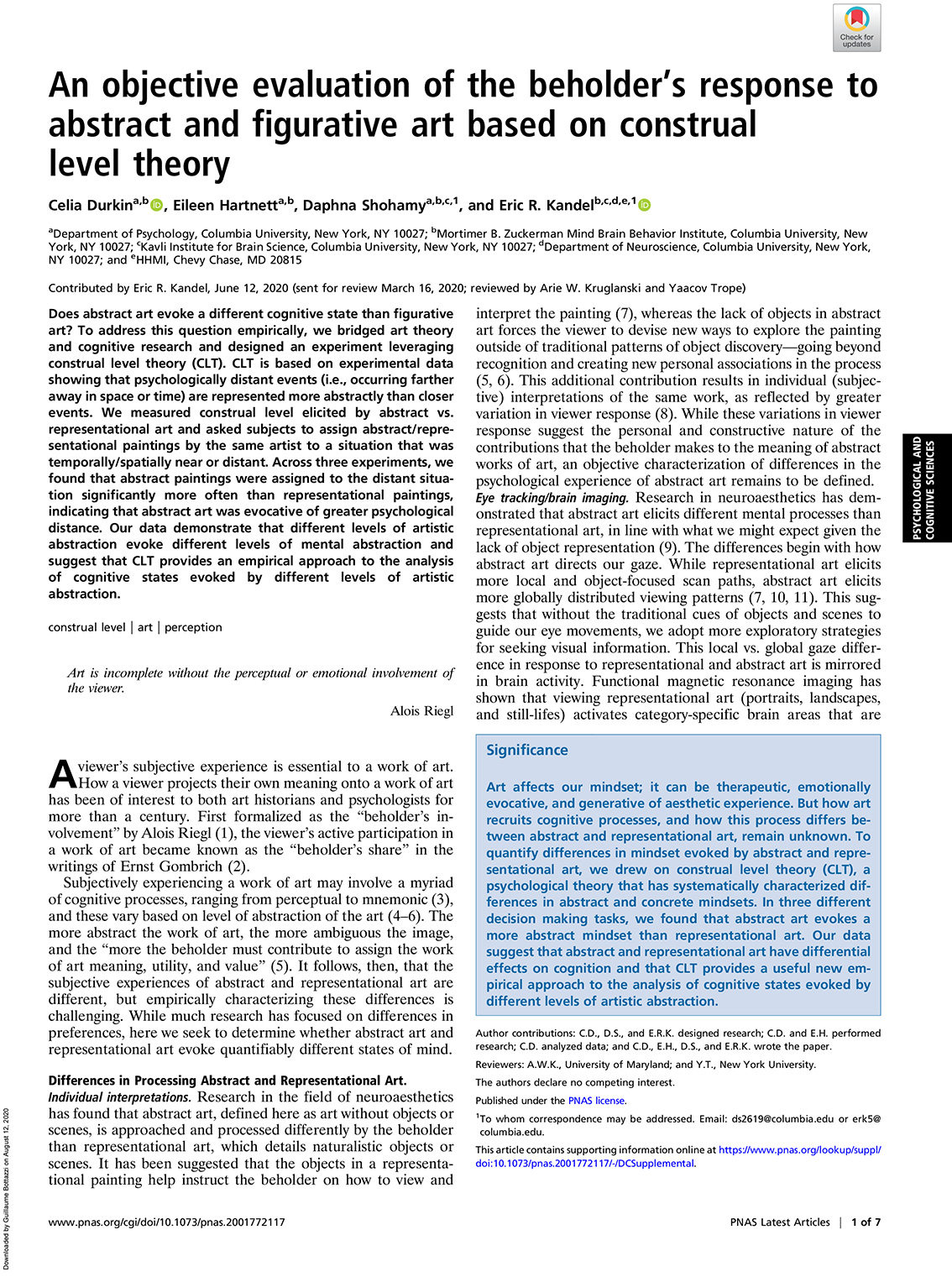
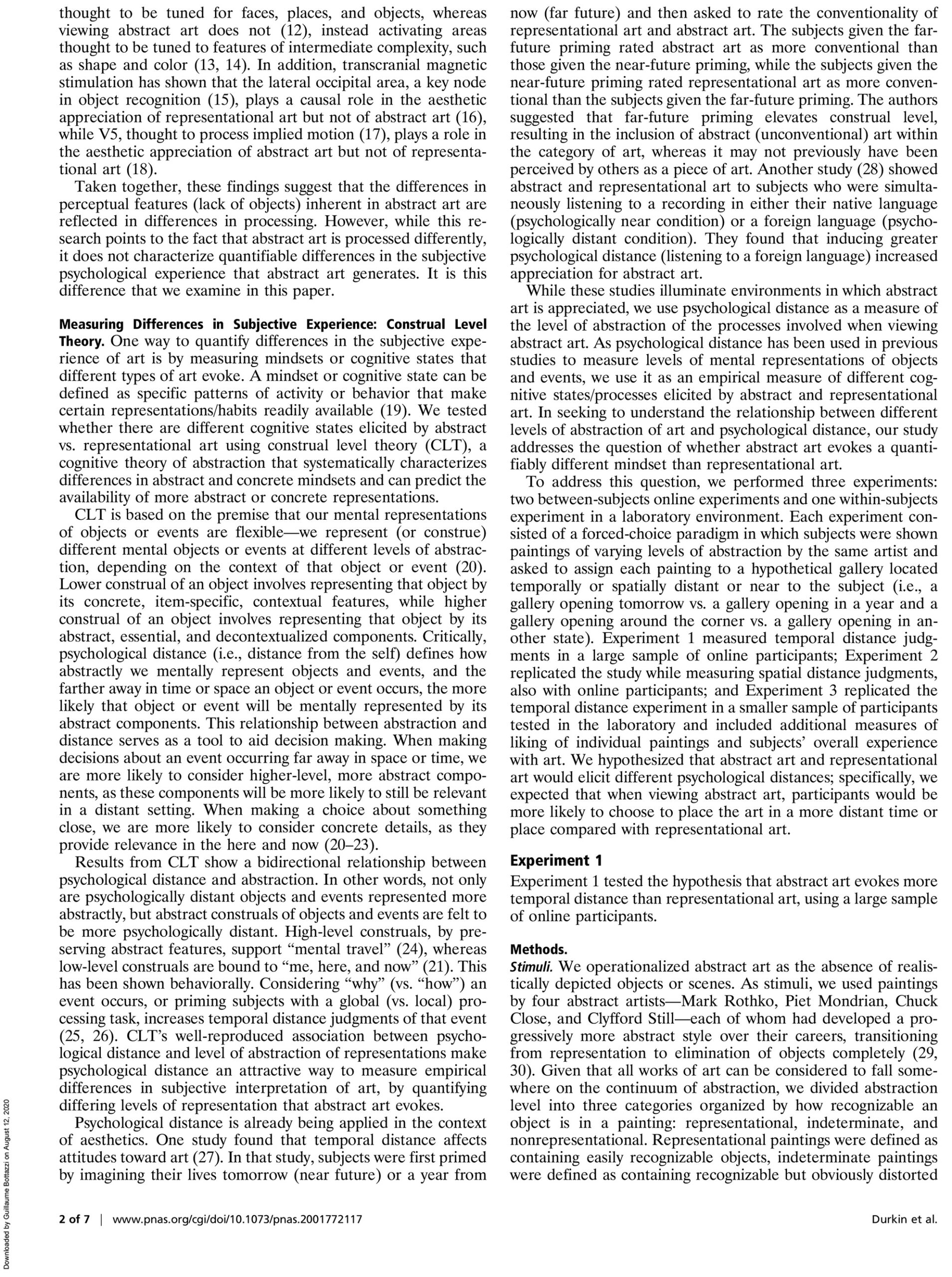
An objective evaluation of the beholder’s response to abstract and figurative art based on construal level theory
Celia Durkin, Eileen Hartnett, Daphna Shohamy and Eric R. Kandel – June 2020
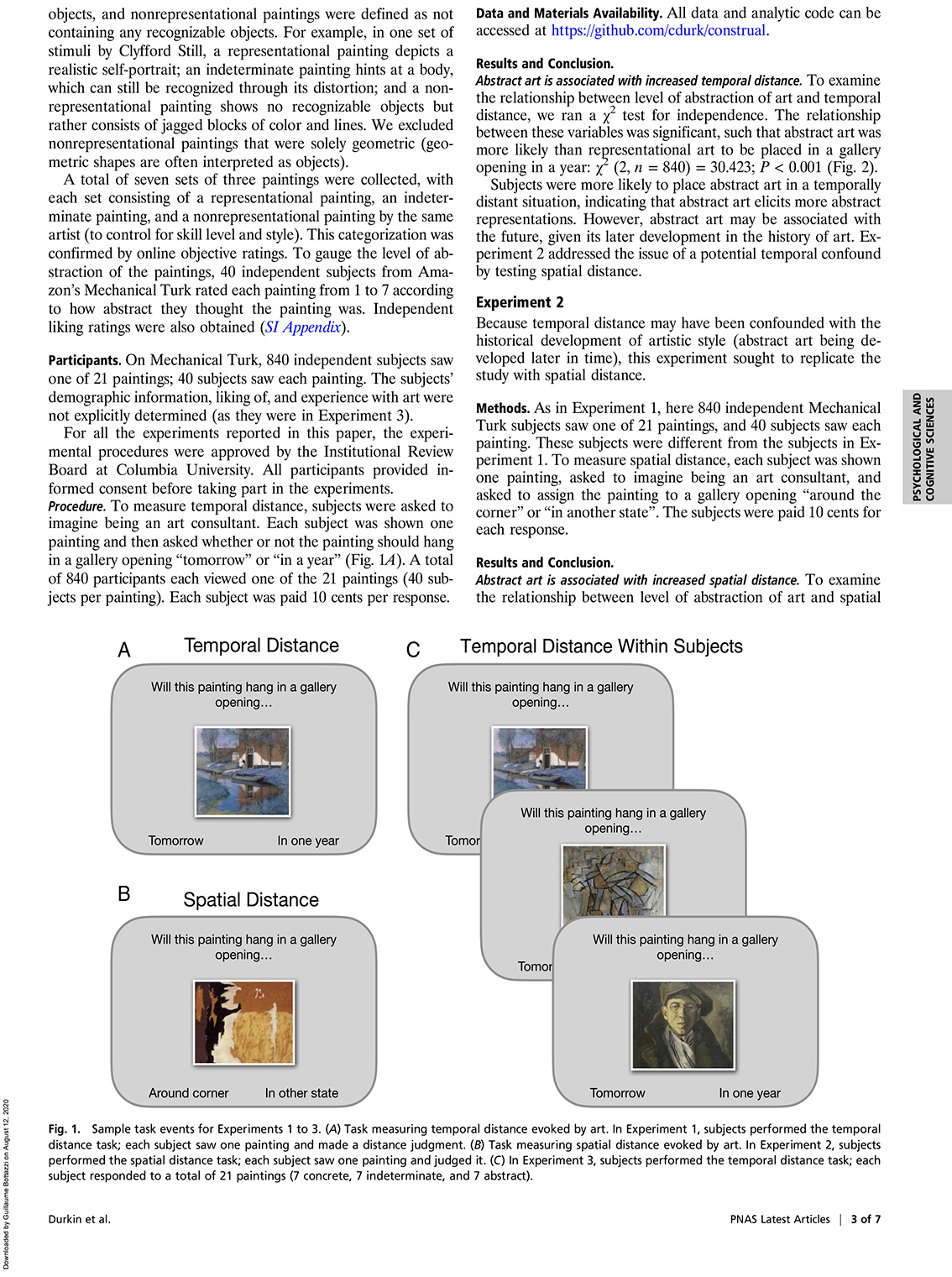
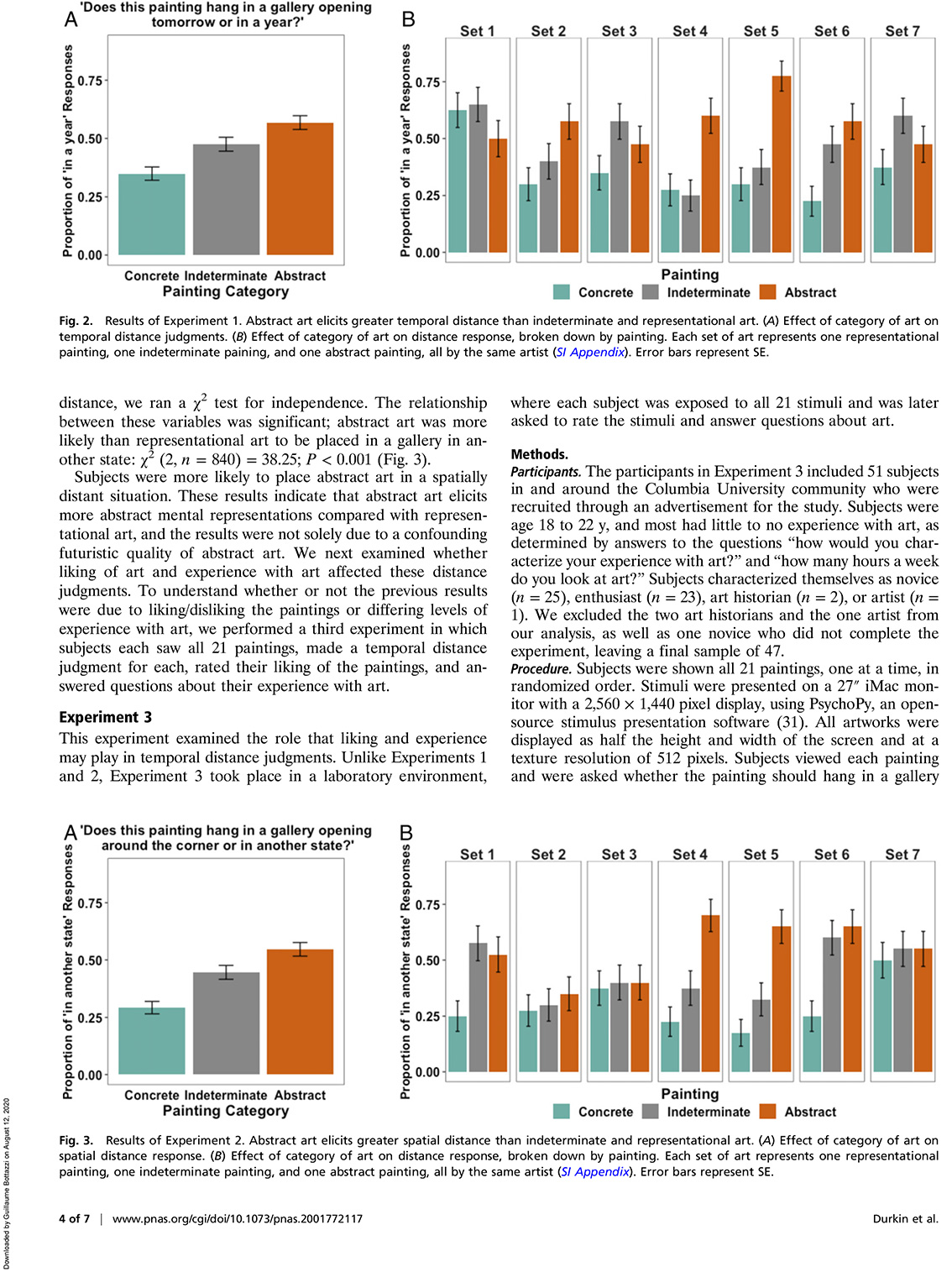
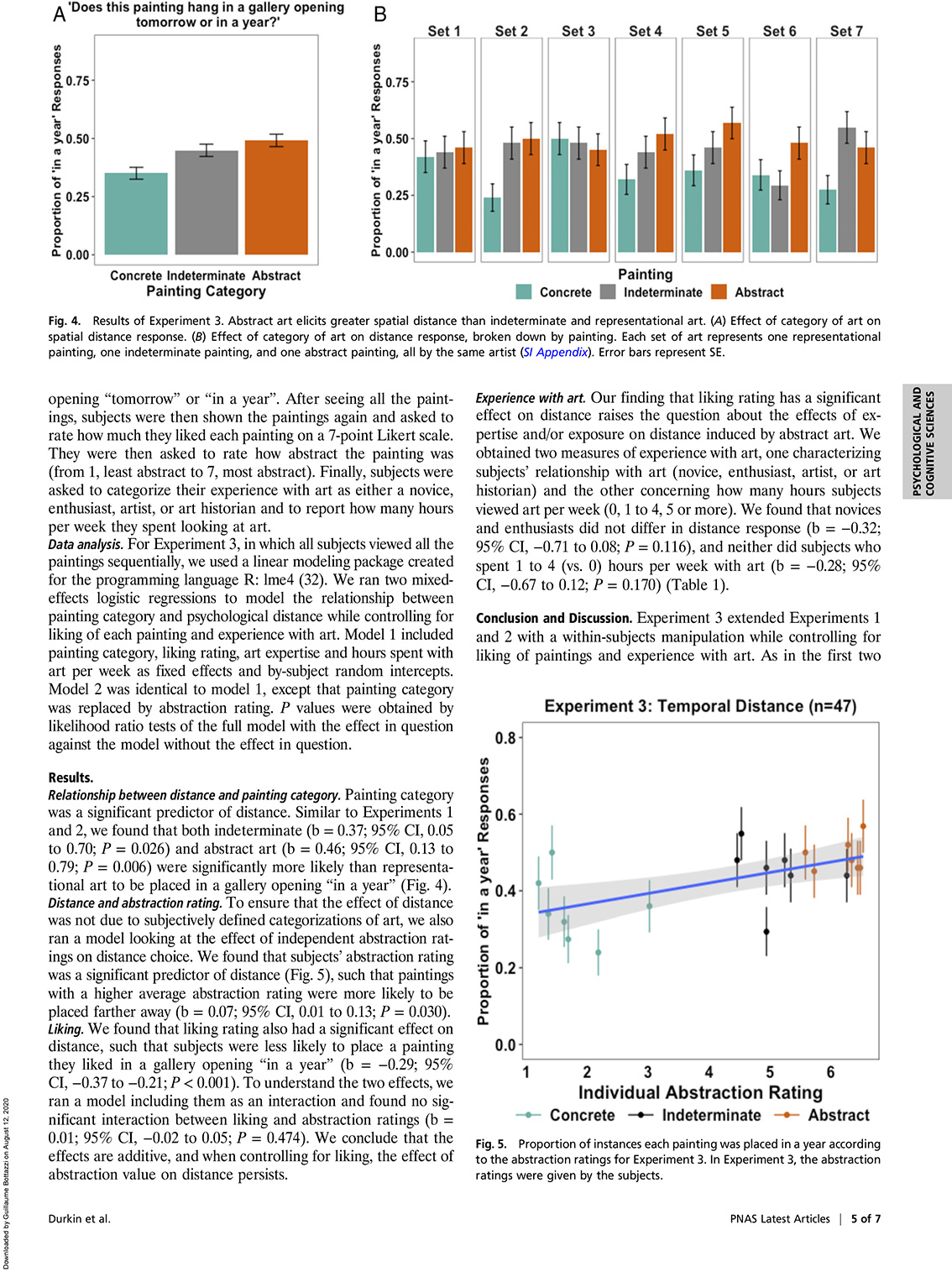
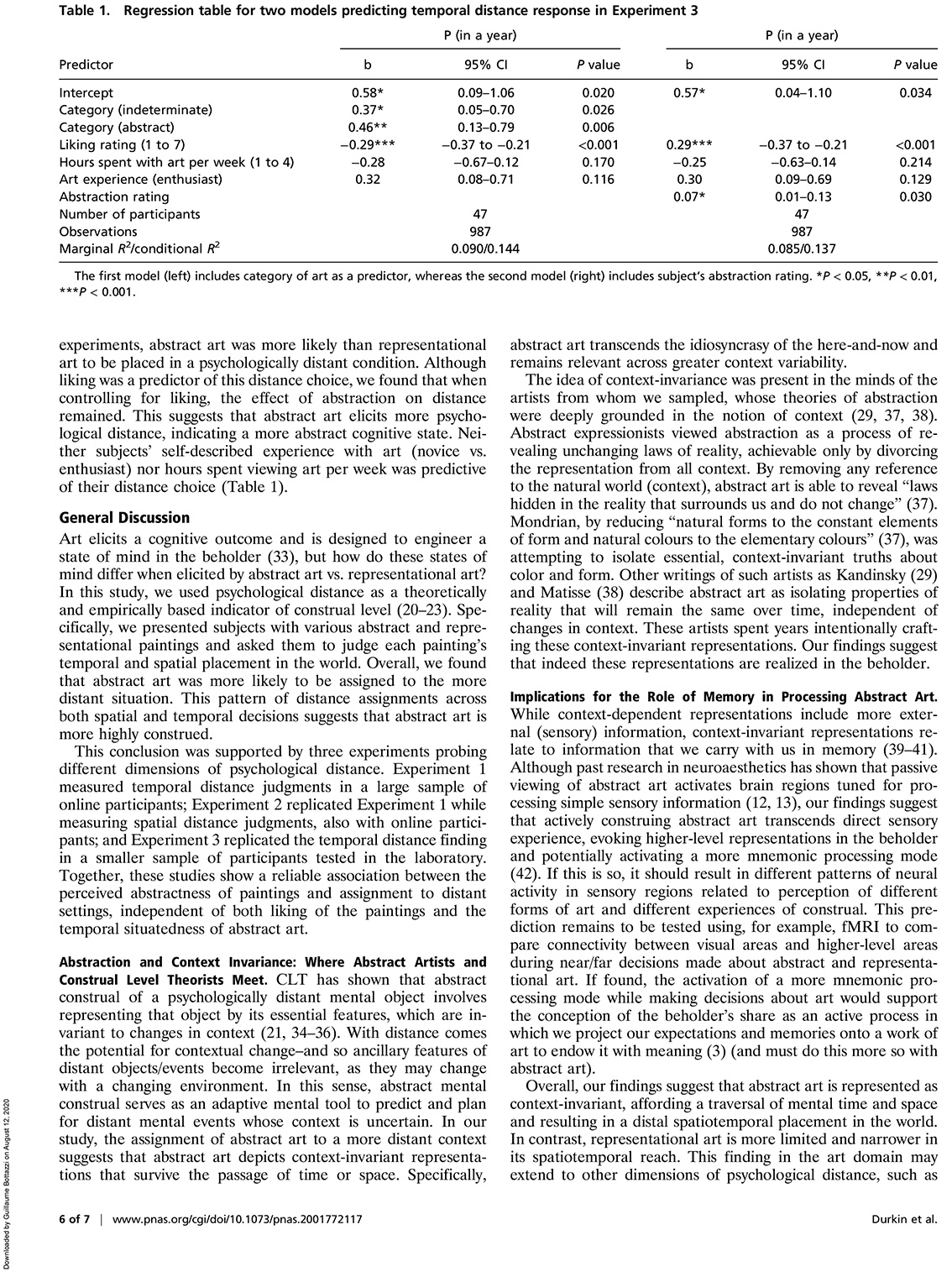
Senses and art
Guillaume Bottazzi – March 2020
The analytical approach in the art world is established in the naming systems; it has become a form of classification that has gained weight and which serves as a reference in the context of the artistic judgement of initiates. This current of thinking was initiated by Wittgenstein, and others have since taken it up.
To introduce the subject and summarise the situation, the analytical approach seeks to destroy the sensory dimension of a work of art, maintaining that our senses offer only a reading at a first level. It considers that art has no essence. This leads those who implement this approach to consider that the meaning of a work of art can only be understood by intermediaries, that is to say, themselves. Thus, these players set themselves up as the only link between the public and the work: this explains how these intermediaries perpetuate their jobs.
The problem with this social elaboration in the art world is that it operates at the expense of public interest, but also of art since it freezes it. The analytical approach in art reduces the scope of artworks, even though the work of art is a malleable, flexible medium: we reinvent the artwork we look at over time.
What Marc-Alain Ouaknin says in Lire aux éclats, éloge de la caresse should be applied to art too, which opposes taking possession or controlling, and allows us to evolve. That is why, from Antiquity to the present day, art has been the subject of never-ending reflections. As Vassily Kandinsky1 put it, “art enables you to rise”.
For Nobel Prize laureate Eric Kandel,2 in Reductionism in Art and Brain Science – Bridging the Two Cultures, art modulates our neurones and it is the cognitive activity of the observer that enables this to happen.
Cognitive activity is the measure of the production of grey matter and of our spiritual elevation. The study by Oliver Sacks, the British doctor, neurologist and writer, “The effects of music on the brain”, presents an MRI which measures the effects of music on the public.3 It shows that if the listener is not sensitive to the music he is listening to, music creates hardly any cognitive activity. However, if the listener likes the music he is listening to, there are many areas that activate. If the viewer is not receptive to the observed work of art, it will have no effect on him. The scientific data seem to agree, because they imply that an approach that denies the sensitive in art also negates the activity of the brain, insofar as it will then develop only in a very reduced way. On the other hand, artworks that appeal to our senses have the power to immerse us and create an aesthetic and cognitive activity.
In a ten-year research on the brain and art,4 Helmut Leder and Marcos Nadal explain that the viewer may find criticism of a work pertinent, but that this will not affect his aesthetic judgment.
On the other hand, in his article entitled “L’esprit est modelé par le corps”,5 the neuroscientist Antonio Damasio demonstrates to what extent the body is inseparable from the brain, and how the latter is able to determine our aesthetic judgment, sometimes without filters.
In other words, to deny the sensory dimension of a work – and even its essence – is like amputating one’s limbs before playing a game of basketball.
1 Vassily Kandinsky, Concerning the Spiritual in Art, 1911
2 Eric Kandel was the 2000 Nobel prizewinner of physiology or medicine
3 Oliver Sacks, The Effects of Music on the Brain – https://www.youtube.com/watch?v=AUT9UTVrwp8&list=PL8FKI9WbQ5tR6S00K4n5Lwn7IgbFLapst
4 Helmut Leder and Marcos Nadal, Ten years of a model of aesthetic appreciation and aesthetic judgments : The aesthetic episode – Developments and challenges in empirical aesthetics, 2014
5 Antonio Damasio, La Recherche, n° 368
Supermodern abstraction
Guillaume Bottazzi – January 2020
The art historian Hans Belting1 suggests calling today’s arts “supermodern” art.
In order to broaden the impact of art, a poetic commitment is a constant in all my works.
The subject is the work of art itself, it is polysemic and surrenders itself to the observer’s elaboration. The work is not limited to a cause that is external to it, that would reduce and fix it, but optimises the effects generated in the observer.
According to the philosopher Martin Heidegger2, a work of art is a power that opens and “installs a world”. It is not a simple depiction, but the manifestation of the deep truth of a thing. Art is itself origin and creation of the world. Art reinvents the world, exalts it, and participates in its transformation. And in fact, art takes part in our development in all things. Numerous writings have illustrated how art is a subject of reflection that has never stopped changing and causing controversy through the centuries, because art is malleable, because it is an intangible and soft matter. The painter Vassily Kandinsky considered that art allows one to raise oneself3. For him, spiritual life is a movement that corresponds to the movement of awareness. In his “essay on the imagination”, Joseph Addison, a seventeenth-century English writer demonstrated that the works we see become part of us and express themselves in the world of the observer4. The convictions of this author are today scientifically proven, notably by the research by the Nobel Prizewinner in physiology, Eric Kandel, who shows how our brain develops in recreating the work of art we observe and why abstract art modulates more neurons than figurative art5. For the painter Paul Klee, “art does not reproduce the visible, it renders visible6”. To paint is to hide, to induce the non-visible in order to optimise the observer’s own elaboration. This leads me to share my liking for the painter Henri Matisse with you because he understood that “the painter’s duty is to give that which photography does not give7”.
The philosopher François Dagognet wanted to “go outside to plumb the depths rather than inside8” while the neuroscientist Antonio Damasio demonstrates that “the mind is shaped by the body”, that it is not only the brain that is mobilised when we look a work of art but also the body9.
Moreover, in his ten-year research on the brain and art10, neuroscientist Helmut Leder of the University of Vienna in Austria has shown that the notion of art is closely linked to each person’s personal experience. This partly expresses my interest in large formats, in environmental creations and installations, since they immerse the spectator, inviting him to move around and add what he sees to the register of his personal experiences.
In a study, two neuroscientists, Helmut Leder and Narcos Nadal, prove that my creations contribute to the well-being of the viewer11. They promote dopaminergic activity and reduce anxiety. The fact of loving a work, of feeling good before it is the factor that will enable it to play its role, as research by Antonio Damasio has shown.
When I visited the Ryōan-ji temple in north-west Kyoto, I sought a global approach, one that incorporates different parameters and gives the impression of infinity. I have abandoned the form and expression of the artist who focuses on himself. I have painted in such a way as to find my own breath, a balance that centres on the energies deployed.
Art must leave the well-trodden path, renew itself, bring the unexpected, surprise us. It must lurk where we do not necessarily expect it, accompany us on a daily basis, transform and reincarnate itself.
1 Hans Belting – The End of the History of Art?
2 Martin Heidegger – The Origin of the Work of Art
3 Vassily Kandinsky – Concerning the spiritual in art
4 Joseph Addison – The pleasures of the Imagination, le Spectator
5 Eric Kandel – Reductionism in Art and Brain Science
6 Paul Klee – On Modern Art
7 Henri Matisse – Interview with Georges Charbonnier in 1951 in a programme called “Couleurs du temps”
8 François Dagognet – Changement de perspective : le dedans et le dehors (A change of perspective: the inside and the outside)
9 Antonio Damasio – La Recherche, n° 368
10 Helmut Leder and Marcos Nadal – Ten years of a model of aesthetic appreciation and aesthetic judgements: The aesthetic episode – Developments and challenges in empirical aesthetics
11 Helmut Leder and Marcos Nadal – Curved art in the real world: A psychological look at the art of Guillaume Bottazzi.
Cultural engagement and incident depression in older adults: evidence from the English Longitudinal Study of Ageing
Daisy Fancourt and Urszula Tymoszuk – 2019
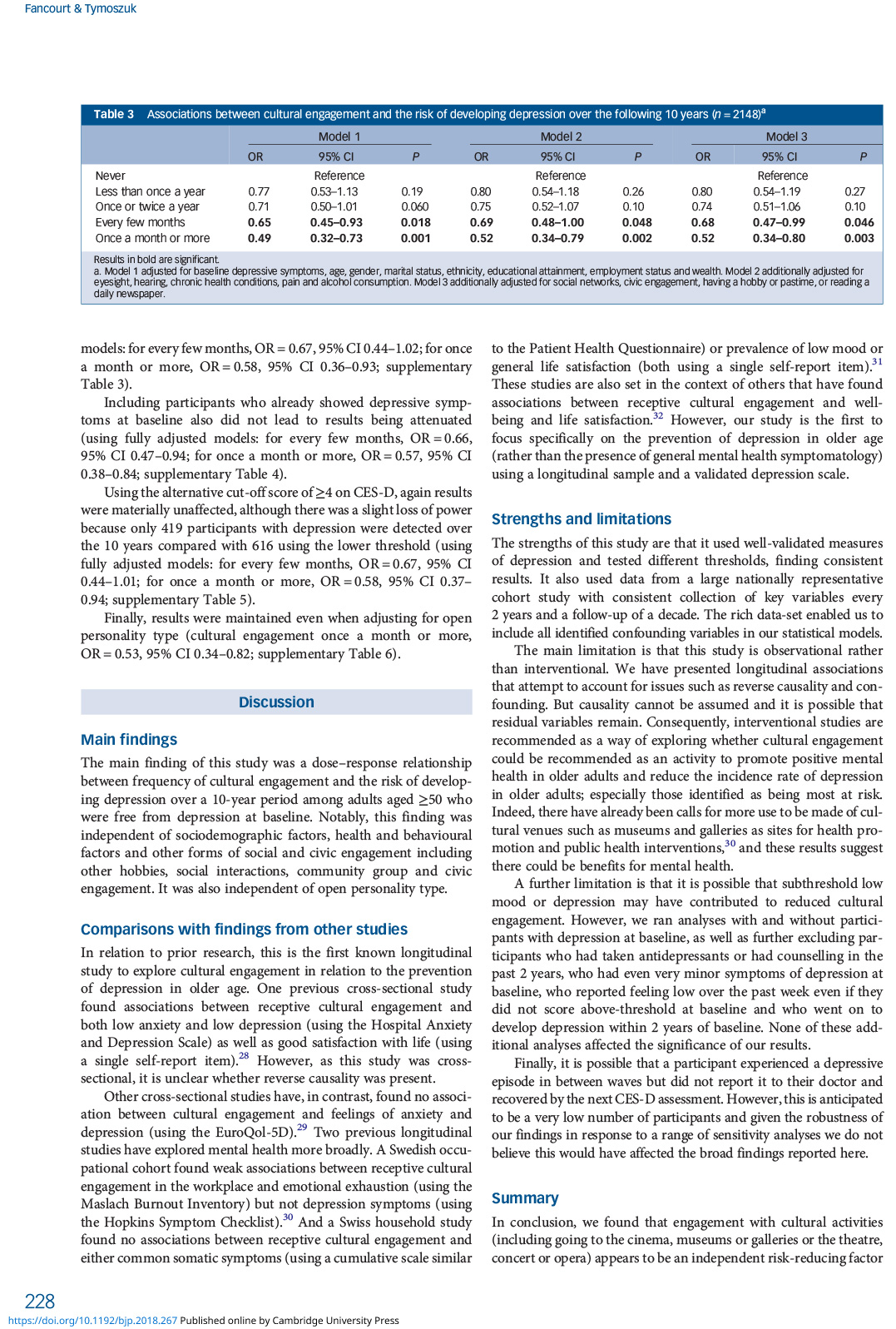
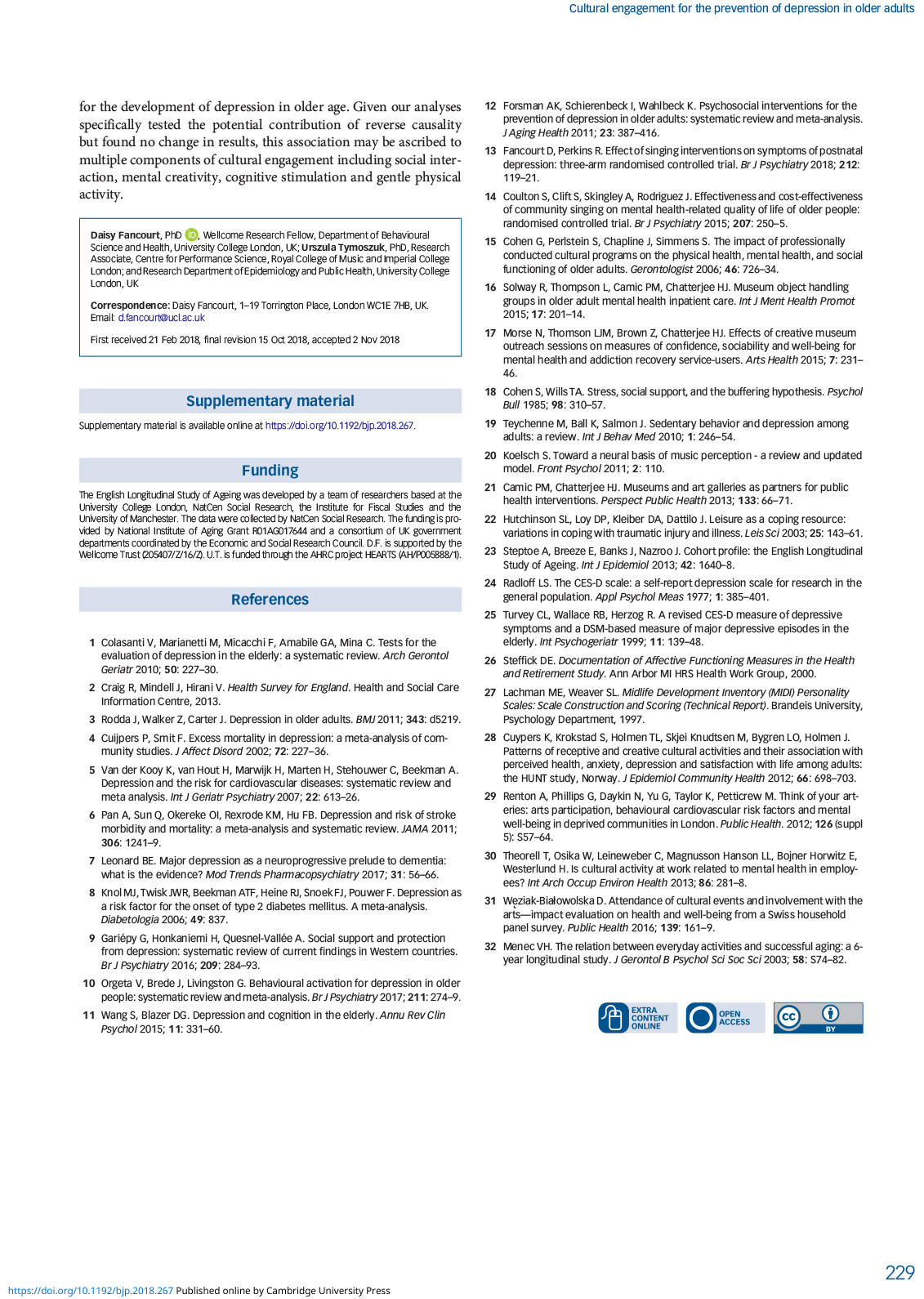
The daily symbiosis between the city and art
Juan Paolo Casado, Bachelor of Hispanic Literature – Arte Al Limite – June 2017
Large-scale interventions in public spaces dialogue with the observers through the psychology that radiates from the pleasure of calmness. The abstract work of the French painter Guillaume Bottazzi seeks to bring the art that regularly traverses the city closer to the citizens. The inspiration originating in the sensuality encapsulated in Latin culture marked the beginning of a life dedicated to art. Guillaume Bottazzi migrated from France at 17 to the Italian city of Florence. It was here, in one of the centres of Western culture, that he started to perfect a visual language that is dedicated to occupying public spaces from the point of abstraction.
“My works in public spaces are usually permanent, but an exhibition in a museum is a fleeting moment”, Bottazzi explains. He has been utilizing open-air structures in urban locations such as Brussels, Hong-Kong, and Tokyo to convey a message that, according to the artist, transforms the aesthetic experience into a daily element. For the French painter, constantly putting work on display for the audience helps him understand and experiment art as a reality that adds value to day-to-day life.
The manner in which the poetics of the artist takes over the space causes an impact on the observer. In a dialogue between work and environment, the bonds between individuals and their environment are emphasized through the monumental scale of each piece. These characteristics motivate the observers to move around to appreciate the piece in its entirety. The immersion achieved through discovery involves all these elements organically. This way, “the work becomes part of the personal experience of the audience”, explains the artist.
“I believe that rules must be broken at the moment of creation,” Bottazzi states. For him, boredom stems from repetition, and inspiration can’t be reduced to structures due to its rebellious and capricious nature. “Creating a work of art, for me, is an act of sublimation, a way of overcoming one’s own personality,” he confirms.
The penetration and impact caused by Bottazzi’s creations go beyond the volume conjured up by three-dimensionality. The interventions are set up as part of the environment; an environment that the visitors reclaim from a new perspective when they see it intervened by the artist. Psychology plays a vital role in this conversation, as it’s the mediator that gives shape to the subjective experience in each observer.
The immersive tools provided by abstract art allow Bottazzi to create ethereal shapes that, as if they were steam, are blurred and blended with the surface. ”The support is an integral part of the piece and gives off the idea of infinity. I ‘m showing the visible and invisible,” the painter says. To exemplify this, it suffices to look at the role of light, which crosses through the frames that delimits and contains each painting.
The large sizes that Bottazzi’s creations usually have require the artist to spend weeks working in public places. From the beginning, the creation of the work is open to bystanders. This performance act opens the intervention to the public that traverse the area. The final result radiates pleasant and calming sensations that accompany the pedestrians that frequently pass by the location of the work. This is how art becomes a daily principle in the life of ordinary citizens.
The vertical and horizontal lines that shape the cities and foster anxiety among their inhabitants are in symbiotic contrast to the relaxing and delightful curves whispered by Bottazzi. In this manner, the audience isn’t directed towards any specific direction, as the works are abstract and don’t carry titles that guide perception under the structure of a predetermined narrative. For the artist, “a work of art defies the creative potential of the observer. Like Kandinsky, I think that art is “evolution”. Art influences the development of the observer.” The author behind the piece acquires a secondary role; it’s no longer the artist telling their story, the intention is to cause a psychological effect in the observer.
Curved art in the real world: a psychological look at the art of Guillaume Bottazzi1
Helmut Leder and Marcos Nadal* – University of Vienna – Faculty of Psychology Department of Basic Research and Research Methods – March 2016
*Helmut Leder and Marcos Nadal, neuroscientists from the University of Vienna in Austria and the University of Palma in Spain, are the authors of a 10-year study entitled ‘The Effects of Art on the Brain’. The neuroscientist Helmut Leder is a researcher, professor and doctor at the University of Vienna in Austria who has carried out 20 years of assessments and laboratory research. For his outstanding contributions to psychology and the arts, he received the Arnheim Award from the American Psychological Association, Division 10, as well as the Fechner Award for his outstanding contributions to empirical aesthetics, awarded by the International Association for Empirical Aesthetics. He is also director of the interdisciplinary research institute Cognitive Science HUB. This study was conducted jointly with Marcos Nadal, a neuroscientist, researcher and professor at the University of the Balearic Islands.
Before you continue reading this, please take a look at the space around you.
You are most likely indoors. How did we guess this? Well, today most people spend close to 90% of their life inside buildings. Moreover, it is also likely that most of the objects that surround you, and the elements that constitute the room you are in, are human-made, designed by a human creator. Have you ever thought about how these surroundings affect the ways you feel, think, and behave?
The artist Guillaume Bottazzi has devoted much of his work to actively designing aspects of the environment. He has achieved this not only by producing objects—such as artworks or three dimensional artworks—that can become part of the environment, but also by interventions that change the visual appearance of large-scale environments themselves. Such interventions influence our perception and evaluation of those surroundings—and much more! For example, how we feel.
This is how Guillaume Bottazzi’s art looks through the lens of psychology. But why approach his art—or any art for that matter—from a psychological perspective? Psychology is the science of mind and behavior. As such, it seeks to understand what makes us who we are as individuals and communities, what moves us and what stops us, what drives us to achieve, what makes us want and feel, and where our joys and miseries come from. An important part of who we are, and of how we feel, has to do with our interactions with our environment; specifically with the way we shape and experience our immediate surroundings.
Today, psychology is mostly practiced as an empirical science; it is based on data that were collected in experiments aiming to test and prove psychological theories. In our daily business as researchers in Psychology, therefore, we often conduct laboratory and field experiments, systematic observations, and collect data that either support or contradict the hypotheses that guide our studies. More than 150 years of inquiry have revealed many things about how the human mind and brain work. If art has anything to do with human emotion and reason, or with how humans view themselves and their world—and we are convinced that it does—then Psychology can contribute to understanding the way art in general, and Bottazzi’s art in particular, is experienced.
When psychology was founded as an academic discipline in the late 19th century, most research was concerned with sensory perception. In the tradition of Herman Helmhotz, and other great physiologists of that time, psychologists aimed to measure the intimate side of simple acts of perception: How does light arriving through the eyes get translated into a sensory experience? How does this feel? Is this subjective experience lawfully related to the amount and intensity of light? Pursuing this sorts of questions produced a greatly successful line of research. It revealed many of the feats and tricks the human mind uses to understand the world, but also many of its biases, constraints, and limitations that help it deal with the vast array of information and events taking place around us. Some of these feats and constraints combine to endow humans with a certain memory span, a limited focus of attention, or the perception of color constancy and visual grouping, among many other possible examples. However, a different tradition has aimed to understand much more complex perceptual experiences, such as apprehending images, artworks, or even the full complex scene of our environment as it appears to us. This approach was already called for by the founders of this “new science” of Psychology in the 19th century, but for many reasons its development was much slower. And, although a science of perception of art is now established in Psychology , the perception and appreciation of our environment has only recently gained a relevant place in Psychology.
What do we know about the perception of our environment? We know that people can identify images as depicting a seaside landscape, a forest scene, or a human-made environment with only a glimpse, even when these images are presented for as briefly as a 1/10th of a second . Regarding preferences for certain environments, we know that people like nature as seen from a safe and hidden vantage point, with some views and possibilities for further exploration , and that people consistently like images that show landscape scenes more than urban scenes .
This latter finding is particularly striking, because we spend a vast amount of our time in human-made environments. If you think of your daily routines, and those of the people you know, it is easy to see how only rarely do people in western countries encounter untouched nature. Why have so few studies been conducted to understand how environments designed and created by humans influence our lives and our feelings? This is one of the mysteries of our research field. It is difficult to understand, because even common sense suggests that the design and creation of living environments might benefit from knowledge about the way that people perceive and evaluate the different alternatives of how environments look.
One thing is very clear, though: people respond to the aspects of objects and places, and among these are basic visual features. Psychologists, and philosophers before them, have long searched for basic visual elements that guide our preferences, and affect our feelings and well-being.
So, are there any general laws that can predict what most people will like? One consistent finding is that curvature influences aesthetic responses. People prefer curved objects to sharp ones . This has been shown for car design, where curved design is often liked more , while apparently taste and fashion also affect such preferences. More systematically, it was demonstrated that when people were shown images of object such as watches, sofas, toys, and so on, on a computer screen for very brief times, then the curved-contour versions of the objects were liked much more . In a follow-up study, these researchers also found evidence that the preference for curved contours is related to lower activity in brain regions that can be associated with fear . So, curved contours could be preferred because they seem less harmful, or plain and simply because they are inherently attractive . The idea that curvature is an aesthetic primitive confirms philosophers’ claims since the 18th century. Burke, for instance, believed that beauty is smooth, without edges or sharp angles. In this respect, Guillaume Bottazzi’s work exemplifies the use of these basic features, which elicit pleasure automatically, probably unconsciously, and are attractive to the eye. Like many artists, he intuitively applies these principles and produces visual doses of sensory pleasure.
This picture of Bottazzi’s exhibition in Miyanomori International Museum of Art in 2011 also show a distinct contrast between the shapes in the art and major architectural elements, such as the frames, the ceiling, the different non-curved sharp angles. The presence of straight elements is not unusual—you may check again your current surroundings.
So the question arises whether architecture might be an exception of our preference for curvature. To find this out, together with a large network of colleagues from psychology, neuroscience and architecture, we conducted a study in which we asked participants to look at carefully selected images of modern interior architecture spaces. They were asked to evaluate each interior space, and while they did so we recorded their brain activity by means of functional magnetic resonance imaging. We examined “how systematic variation in contour impacts aesthetic judgments and approach-avoidance decisions, outcome measures of interest to both architects and users of spaces alike.” (p. 10446).
The people who took part in our experiment found the interior spaces with curved contours much more beautiful than those composed mostly of straight lines and corners, as in the other aforementioned aesthetic domains. The brain imaging results showed that viewing the curved contour rooms was associated with an increase in activity in the anterior cingulate cortex, a brain region known to respond to the emotional importance of objects and to their rewarding aspects. We were also able to show that participants’ beauty assessment and their concurrent brain activity were driven mainly by pleasantness. From these results we concluded that “the well-established effect of contour on aesthetic preference can be extended to architecture. Furthermore, the combination of our behavioral and neural evidence underscores the role of emotion in our preference for curvilinear objects in this domain.” (p. 10446)
Thus, even in architecture curvature elicits pleasant feelings, which lead to a stronger appreciation of beauty in architectural designs that contain such curved visual features. This is a crucial finding for two reasons. First, it was believed that such preference was primarily related to objects that could be handled and grasped. We now know it also applies to the spaces that envelope us. Second, most of the architectural spaces we inhabit are not curved. However, Art has the potential to bring this feature in. This is what Bottazzi’s work does. The examples in Figure 2 show how very straight shapes, cube-like buildings, are camouflaged by the wall paintings of Bottazzi—not only do they bathe the façades with color, they also resolve the shape towards a more pleasing, aesthetically preferred curvature and roundness.
In this respect, Bottazzi’s interventions are part of a long tradition of using wall paintings to create illusions that do not correspond to an underlying physical structure—as seen, for instance, in baroque architecture or the Spanish art-deco movements, most known through the works of Gaudi. However, the design of human-made environment could benefit from knowledge and research and insight about the factors that affect people in their living environment.
Thus, the perception of art and architecture from a psychological perspective reveals that both produce fascinating objects that bring pleasure through beauty and aesthetic qualities into our everyday life and surroundings. If our thoughts are correct, then you should also be able to receive small doses of pleasure by looking at pictures of—and surrounding yourself by—Guillaume Bottazzi’s art.
1 University of Vienna / Universität Wien : https://ucrisportal.univie.ac.at/de/publications/curved-art-in-the-real-world-a-psychological-look-at-the-art-of-g/
Brain and art
Guillaume Bottazzi – January 2016
Sensory perception is created by arousal or stimulation which itself produces a reaction.
We are able to see an object only if the information passes through the cortex.
That explains why our vision is not simply a mechanical phenomenon but is also connected to mental elaboration.
The perception of a form induces the perception of meaning (a symbolic process); according to Gestalt theory, in an abstract image the whole perceptive system prevails over the sum of its parts.
Excerpt from the “Abrégé de psychologie” (“A compendium of psychology”), by J. Delay and P. Pichot, 4th edition, Editions Masson – Chapter IV / La perception.
Aspects psychologiques et psychopathologiques (Perception. Psychological and Psychopathological Aspects) / page 55 (translated here).
c) The Tau and Gelb Effect. – It combines the two preceding series.
When three equally spaced bright spots A, B and C are presented one after another and the temporal interval between A and B is inferior to that between B and C, points A and B are seen as closer together than B and C.
A few optical-geometrical illusions. On the upper left side, the Müller Lyer illusion.
The dot divides the arrow’s shaft into two equal halves.
The portion on the right appears longer than the portion on the left.
On the upper right side, the oblique line is comprised of two segments which are a continuation of each other. The upper segment appears shifted to the right.
On the lower left side, the bases of the three trapeziums are equal.
On the lower right side, the six lines are parallel.
Brain and art
The diagrams above show that we do not see the individual parts but the whole; our overall view creates an optical illusion, our perception may be distorted but, above all, all our perception reinvents the world.
Perception is not an objective reproduction of the world
– If a picture represents an apple (we can define it as round, red, judge its size, etc.), cognition begins and the subject is identified. The apple refers to a notion of apple which exists for the observer. It can be connected to an affective process, for example by recalling a memory such as the smell of the pies the observer’s grandmother used to bake. The observer is active in front of the image.
The constancy of colour :
If we ask an observer what is the colour of coal in direct sunlight, the observer will see it as black. Similarly, a pile of snow at dusk will appear white. And yet a photoelectric cell shows that coal in sunlight is lighter than snow at dusk.
There is a constancy of colour in our brain and meaning belongs to the person looking at it : snow is invariably perceived as white.
The abstract image constructs us
In front of an abstract image, the observer’s symbolic process must construct the image differently. Indeed, the observer cannot rely on his or her experience in this case. Abstract artwork commands mental effort and this cerebral activity is part of our development.
Understanding becomes disconcerting because there are no references; it requires us to think harder.
Thus, the observer must make an effort to identify the image, to understand it.
Moreover, we see what we want to see or what we need to see.
Our motivation determines the field of hypothesis and as such modifies the field of our perception.
Perception is action, the perceptive act with which we structure the world. It is tied to what is acquired, which implies that it evolves and that there is no absolute nature.
cf.: The empiricist theories – Piaget / the child’s developmental stages – perception is learned.
Kilpatrick Experiments:
– A room is crooked, the walls are not straight.
Inside, a man touches the space, a degree of transfer occurs, he understands the space with his hands and as such finds his bearings; this implies that perception evolves.
– We put glasses which invert left and right on an individual. The brain then reinvents the correct direction. Innate, acquired, compulsive and affective perception can change with experience.
Art must be brought to everyone
We can distinguish acquired from innate in perception.
Abstract artwork does not impose a subject; it frees us from our references.
What is acquired becomes a determinant; in other words, looking at artwork will help mental elaboration. Hence the importance of making art accessible to a large audience: the presence of artwork improves our knowledge and the development of our capabilities. The more artwork we see, the more we are prepared to receive it and accept that there is no single, unique vision of the world.
Understanding the French artist
Chaubau – Scarcity Hong Kong – May 2016
The following story is typical of a modern artist: at the age of seventeen, the decision is taken to become an artist; the family is against it, believing their child will die from hunger; and the child leaves home to make his dreams come true. Maybe some people haven’t heard this story before, but it is inspirational and its protagonist is the French artist Guillaume Bottazzi.
The French fine artist Guillaume Bottazzi is holding his first exhibition in Hong Kong, where he is showing 23 recent large scale works in three exhibition halls at the Hong Kong Central Library.
The second part of this inspirational story is that during the next five years the protagonist, Guillaume Bottazzi, became a full-time, internationally known artist, who gained fame and fortune, producing over 40 works in public spaces.
I was surprised by Guillaume Bottazzi’s modesty when I met him for the first time. Despite his reputation and his rich international experience, he is as shy and simple as a young man. Despite the emphasis he places on the art of the previous four centuries and despite his international reputation, he describes himself as a young artist, and when he says that his work is the expression of a great idea he does not say it with the tone of authority but he looks at you with a serious expression and tells you, smiling shyly, that “I want the public to have its own view, you should use your own imagination”.
I do not understand Guillaume Bottazzi’s many works, but I feel very comfortable with them, almost at peace. Looking at the lines and shapes that float against a monochrome background makes you really want to ask the artist what they mean and what ideas they convey. Then, as you continue your visit of the exhibition, you realise that none of the paintings have a title. When I quizzed the artist, he answered that the graphic lines are not physical references but carry with them their own emotions and make you organise your thoughts. Asked about the atmosphere he wants to create, the artist answers “I want to know what you think”.
To discuss this I take as an example the most colourful painting with a plain background that fills an entire wall. Here is the resulting exchange: I said that in this painting I saw a kind of prehistoric microbe, with shells. He listened carefully and nodded, non-committal, finally saying that his works are “the freedom of painting” and draw something by themselves. The painting often reveals transparent objects, distilling light and shadow in a traditional way and then you notice that the angles of light projection are in fact irrational, that the light comes from every direction, vertically and horizontally, in scattered films. It is a creation that refuses to take physics into account. The artist says he just wants to create an atmosphere of the image, so that it can interact with the environment.
I would say that Guillaume is a serious painter, from the way he dresses to the way he carries on a conversation, but we shouldn’t be fooled by appearances. He is the first to have come to Hong Kong for an exhibition and be prepared to talk directly to visitors. He is also personally leading workshops during the exhibition, where you can meet him and enjoy a rare creative experience. The work produced during the workshops will be shown in the exhibition hall.
In 2011, Guillaume Botazzi gave a marvellous new look to the Miyanomori International Art Museum at Sapporo in Japan. He spent three months producing a 900 m² painting on the outside walls of the museum, using the red, orange and yellow colours that are his mark. It is currently the biggest painting in Japan. Four documentaries are being shown in the exhibition, one of which explains for the first time the process of producing the work.
Finally, I asked the painter to choose one of his favourite works in the exhibition, so that I could take a photograph of him in front of it. He answered that “My favourite work is not in this exhibition, because it hasn’t been created yet; it is the next one that I’m going to paint”. I was now used to his way of replying, so I didn’t panic. I chose a painting with a bright pink background on which several circles resembling floating white bubbles were painted. Guillaume Bottazzi stood in front of the picture, demonstrating that he thought it was an interesting choice.
I told him “I think pink resembles your character, that’s why I chose the painting”. He replied: “Pink is my favourite colour, it creates a feeling of happiness; I want my paintings to make people happy…”
Colours take flight
Guy Gilsoul, art critic – Le Vif L’Express – November 2016
Guillaume Bottazzi (born in 1971) occasionally forsakes canvas for a gentler, even a silkier textile, pulled taught and whose red colour serves him as a background.
Like Matisse, he has understood that a fabric’s texture has the ability to radiate and create the impression of infinite space. At this point, he hasn’t yet picked up a brush. This living surface is not a “background”, a wall in relation to which the form will become a relief, a weight. The brushwork will resemble the brush strokes of Japanese calligraphers. Bottazzi will lay down traces of colour, often white, always pale, as though the essential concern is to retain the breath in the gesture. But he is not a calligrapher. His hand is directed more in a caress than a movement. It works slowly, precisely, sometimes using a system of stencils, as do the master-creators of kimonos. Bubbles form, seeds or cells, or yet again comma form and swell from a trembling void, slowly rising to the top of the composition. Sometimes whiteness is achieved with a light drift of plaster. Sometimes a glaze of oil colour is deposited on the surface. Often chromaticism is restricted to the definition of an outline, as Western painters used to do when representing a tear, or a drop of water. These works without titles invite the spectator on a spiritual voyage. Bottazzi has also made a name for himself in the field of wall paintings. He has produced around forty so far, the latest of which is a fresco that is being created right now at Place Jourdan in Etterbeek. We prefer works that are on a human scale, leaving to architecture the right to defend itself using its own language.
Guillaume Bottazzi illuminates the walls
Christian Schmitt, art critic – Le Nouveau Cénacle – September 2015
Guillaume Bottazzi, a French visual artist born in 1971, has become well-known for his many monumental “wall paintings”. Already greatly appreciated in Japan for a giant 900 m² painting produced in 2011 on the facade of the Sapporo museum (the Miyanomori International Museum of Art), the artist was approached in December 2014 to carry out a 216 metre work at the foot of the D2 Tower at La Defense in the Parisian business district.
With this work, he has just completed his 70th work in the legendary site of what may rightly be described as the largest body of modern and contemporary art in the open air in France.
Indeed, the business district is already filled with an impressive collection of artworks as diverse and varied (sculpture, painting, stained glass windows, frescoes, etc) as the artists themselves from Calder to Richard Serra, including Miro, Bernar Venet, Takis and César. Now there will be an additional work of art at La Défense for people to admire as they walk past the foot of the building. The work will certainly attract and may even intrigue people
The most fascinating and intriguing aspect of this work is the surprising, even strange distortion that exists between the apparently cold and neutral material support and the warm, almost enchanting gentleness of the compositions.
The coldness of the walls encounters the gentleness of the painting
The artist usually works on uniform fibre cement surfaces that may sometimes even be mobile (a wall on top of a wall) or a support on a rail. This was the case with the 2013 work he produced on a building in La Ciotat (near Marseilles), more specifically in the district of L’Abeille.
In general, the walls that G. Bottazzi uses are always impressive due to their monumental scale and their coldness. Yet they are never amorphous. They always radiate an internal strength relating to their materiality. Hence they often appear grave and austere, even solemn, in their power.
They often form the envelope and the shell of prestigious buildings (museums) or Business Centres (La Défense) as well as more modest residential buildings (La Ciotat). On the other hand, they all have a frontal presence: the vertical, devoid of a centre, is the obvious sign of elevation to the sacred! As a material, the wall may also evoke something dull, mute and sombre. This is the mysterious medium on which this artist works. In addition, he almost always uses scaffolding, maintaining direct and effective contact with it.
This means that G.Bottazzi can contemplate the wall constantly, following the example of Bodhidharma, known as “the wall-gazing Brahmin”, who founded Chan, the Zen of Japan. The special attraction that Japan holds for this artist is easier to understand now! The same Brahmin spent 12 years meditating in front of a wall in order to attain enlightenment, in other words perfect insight into reality. Consequently the wall we come up against, that we Westerners think of as empty of meaning, is experienced differently in reality by the Zen practitioner.
For him, the importance lies elsewhere, in the transmutation of the wall into enlightenment. Indeed, for mystics, darkness and enlightenment are one and the same thing. And, in the end, isn’t this distortion or opposition that we thought we perceived between the coldness of the wall and the pictorial warmth of the work just as absolute?
Hence the other, not insignificant, question: in his own way, has the artist not also taken a path similar to that of the Brahmin?
Could this explain the clearly enlightened nature of his painting? But without the pretension of supplying a definitive, unequivocal answer, the debate will continue. In spite of this, we may say without any hesitation that this artist’s painting seems to be marked by an experience comparable to that of Zen.
All the more since such a statement has the benefit of making the work of G.Bottazzi, more recognizable, especially the work at the Sapporo Museum.
The latter resonates like a powerful, colourful hymn, full of hope and optimism, just like the bulbous shapes that are harmoniously entangled and intertwined. They surprise us, seeming to want to fly away, like Montgolfier balloons leaving the ground to soar up into the sky.
This invitation to a voyage reveals the phenomenon of transmutation that has been considered previously. A transmutation that leads to the profound transformation of one substance into another and to movement from one world to another. This confirms the statement by the psychoanalyst and anthropologist Olivier Douville, who has perceived an identical appeal, asserting that:
“Large painted walls look like steamers coming towards us, inviting us on a voyage; they brighten and uplift the tones and rhythms of urban space.”
In addition, as though to facilitate the same odyssey, G.Bottazzi uses his tried and tested glaze technique to soften a kind of pictorial severity and permit the voyage to be smooth.
In his own words, “It brings a great deal of gentleness to the painting”.
His painting really cannot be reduced solely to anecdotal detail.
By giving priority to movement, G.Bottazzi quite simply includes his work in a more vast and more prestigious artistic approach, since it follows the path first taken by a certain Kandinsky.
This marvellous painter in fact chose abstract painting transformed by change and movement instead of fixed geometric shapes.
Abstraction based on movement and change
Contemporary abstraction very quickly developed two opposing trends, one based on geometric shapes and the other on organic forms.
The two approaches corresponded to two very different views of the nature of reality. The geometric abstraction that is a part of Platonic philosophy should lead to more formalist painting, to “art for art’s sake”, in accordance with the concepts of purity formulated by the American art critic Clement Greenberg. Art that is free of all forms of narration, representation and subject matter. This was the direction taken by abstraction and freely developed by the De Stijl movement with Mondrian, but it is also expressed in more static geometric works such as those of Barnett Newman and Mark Rothko.
Although Kandinsky was just as fascinated by the mystic aura of geometry, in his view abstraction revealed quite a different reality. It was based principally on movement and change and related to living things. This great painter led the way to organic abstraction.
We discover the same vision of abstract art with G.Bottazzi too, first of all in his shapes with their softened and “natural” edges; and then in those that look like living organs. The artist loves life and has no hesitation in saying so in his painting. The body is often evoked even in shapes that are allusive or simplistic such as those resembling an embryo or a foetus. In reality the painter favours metamorphoses of all kinds. They stimulate his imagination and give meaning to his art.
Nevertheless movement and rhythm remain restrained with G.Bottazzi. He always tempers his emotions.
Unlike the incisive and intrepid gestures that we find in the work of de Kooning or Pollock the work of G.Bottazzi is related more to the disciplined and rhythmic work of an Oriental calligrapher.
Sometimes, like many current painters, the artist blithely cross the borders between the organic and the geometric and rediscovers lost visual pleasure.
A return to Op Art and the idea of beauty
In the 1960s, following the lead of some American painters who rejected the puritan principles of the purity of geometric abstraction, many artists joined the figures of organic abstraction.
Their concern was to rediscover the joys of aestheticism.
In fact all these abstract painters, such as Brice Marden, often “mix together”.
Most of them go on to use organic abstraction to mark their return to Op Art.
Philip Taaffe et Ross Bleckner rehabilitate a type of art that tends towards beauty.
Similarly, we find an identical approach to Op Art with G.Bottazzi.
In some of his works, the artist uses vibrant surfaces with the obvious aim of cultivating the “spirit of the eye” (l’esprit de l’oeil).
He has no hesitation, either, in mixing the geometric with the organic for sheer pleasure!
The artist remains an ardent advocate of floating compositions that make use of all the techniques of perspective, not to mention spatial illusion, in the manner of Al Held.
Hence the various evanescent patterns that often seem to be suspended in a zone of weightlessness.
In the canvas in the photo above, the artist has created an area that is just as magical, still with floating organic shapes and a perspective of depth. This results from the arrangement of the motifs that pirouette and sometimes secretively appear to conceal themselves. This gives rise to an almost unreal beauty close to minimalist austerity. But there is still one question: isn’t this need to return to beauty anachronistic nowadays?
Art currently no longer claims to enchant, since, according to Jean Cocteau, “beauty limps”! Yet Fiodor Dostoïevski’s statement that “beauty will save the world” has never been more true and justified than nowadays. This message is carried and idealised by artists especially who, like G.Bottazzi, enrich the world through this attraction to beauty.
Even though the nature of contemporary art is above all to question, even to shock, art will always fundamentally remain an expression of beauty related to passion.
In this respect it is useful to recall the words of Bernard Bro concerning the passion of artists:
“The passion of artists is not the same as that of saints. But it’s still “passion”. From one generation to another, it is stronger than they are and they remember that the search for beauty starts with terror, the dizziness of the solitude known to each person who enjoys their freedom. One day the person who sees that “life is worth nothing”, also discovers that “there’s nothing like life”.”
(Bernard Bro, La beauté sauvera le monde, ed. Cerf,1990, p.364).
Ten years of a model of aesthetic appreciation and aesthetic judgements: The aesthetic episode – Developments and challenges in empirical aesthetics
Helmut Leder and Marcos Nadal – Jully 2014
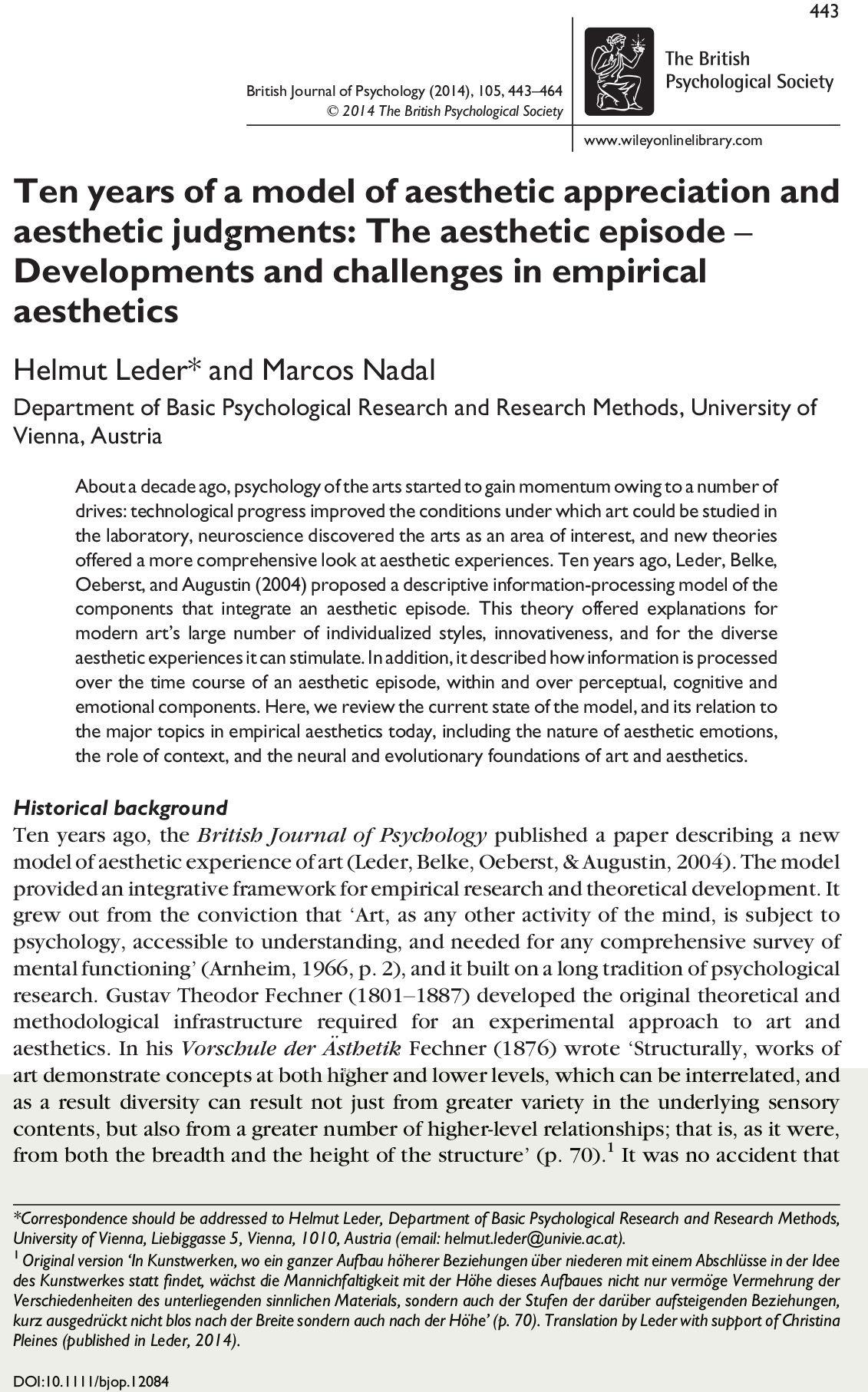
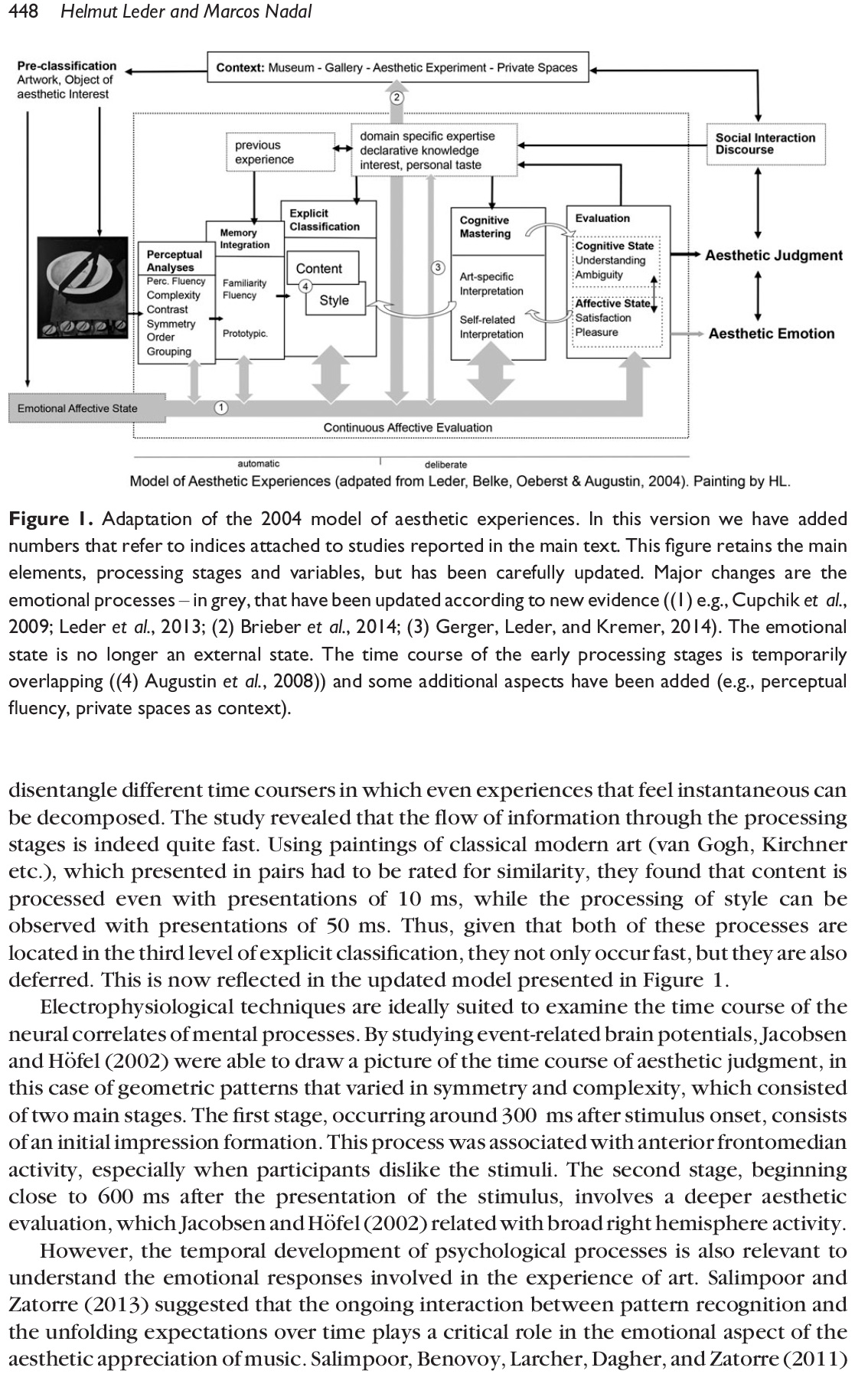

Colours, passages and time: thoughts on the art of Guillaume Bottazzi
O. Douville, psychoanalyst and anthropologist – May 2012
Those who have spent even a short time with Guillaume Bottazzi will have encountered his subtle medley of determination and sensitivity. He does not talk about his art like a journey that can be summed up or like a career, but rather like a gesture, one that nourishes an emotional grammar of space. His art is receptive and unfamiliar with the formal divide between spectator and artwork since he has overcome that chasm and is able to make the forms and colours of bodies and sensations flow together in strategic parts of the city, inviting spectators to inhabit his paintings rather than simply observe them. Large painted walls look like steamers coming towards us, inviting us on a voyage; they brighten and uplift the tones and rhythms of urban space.
Guillaume Bottazzi is able to make formal metamorphosis materialize before us and is as such able to reunite and reconstruct things long separated – public and private life, body and mind; he relentlessly works on the enigma of the spectator’s presence within the paintings and surroundings observed, and yet never is his work, albeit very free, in any way immediate or strictly spontaneous. It is much more. It is solidly rooted in both a culture and a passion. That of Italian art, of Fra Angelico, studied early on, when the artist was barely in his twenties. Then came a passion for travel, trips and encounters. Next, things flourished and accelerated: a studio in Lyon, consecration in America and the Japanese adventure starting in 2004.
And then Asia. A world in which art conjures as much as it shows; a world in which deliberate obliqueness and fertile allusiveness demand different approaches to seeing and sensing. A foray into otherness, too. A constant, turbulent renewal. A modern and intense blending of speed and depth of perception. Museums where movement fuses with new creations to create events in city space and thus re-present, reclaim and reconstruct the body of monuments. This is the case at the Miyanomori International Museum of Art in Sapporo where the museum’s facades have become the backdrop for a Guillaume Bottazzi creation covering 900m². Another monumental mark left on Japan is an abstract work of 3.30 m by 33 m long in Tokyo which alludes to the traffic flows and haste which pulse through and shape space in a district that never rests, is always on the go, eventful and which finds in this masterpiece its glistening and moving reflection. A work that become part of the inheritage of the city, monumental and thus visible from numerous vantage points which are more or less errant or stationary, up close or distant, attentive or furtive; the presence of the surface in these variations of intensity creates a desire to look at the painting by moving with it and almost within it. Perception of Guillaume Bottazzi’s work is thus subordinate to the body of all those who encounter it. A body summoned, provoked and then finally invited to move beyond the banal acknowledgement of a lifeless or frozen gaze..
There is something very musical at work which stems from a perpetual swaying between the different possibilities of what is seen, the interlacing of its layers and dynamic. The work is not solitary, sentenced to the silence of seclusion; it becomes serial, calling for and at the same time creating a very large audience which is at once its inspiration, witness and protector.span>
An art of connections and metamorphosis. Creating, giving us much to see, but not trying to explain any more than necessary. Getting others equally involved. In Japan, France or elsewhere, the regorous generosity of Guillaume Bottazzi makes him present for all those who look at and inhabit his work.
Here too, and again, Japan – where cultural mediation is non-existent – serves as a telltale territory. Working with spectators, getting them involved in the time it takes and for the duration of the creation, talking to them, appearing as a body that is set up in a place while creating forms, rhythms and colours, all of this forms an event. If Guillaume Bottazzi’s art is able to upset fixedness with a stream of transformations, it is certainly because his presented and monumentalized art calls out much more so than would something that is finitely set. I see the source of an adventure that uses a backdrop and network of sensations to test of what the spectator is – deliberately or unwittingly – capable. The artist’s aesthetic adventures call on sensory components which ground the body in time and space. With their resounding and gleaming physique, vivid materiality, joyous yet controlled turmoil, and through the spaces in which they exist, the artist’s creations encourage transformation.
If, at each encounter, they seem to float, imbibed with lightness and scansion in the overly geometrical and cumbersome layout of flat and cubic space in our cities, time is nonetheless present. And, as such, the paintings are also slow, they require endurance and our relationship changes with each one. And then they become independent again. They once again become what those who look at, visit and feel inspired by them, wish them to be. The paintings journey on with each publicly commissioned piece.
I would really like to insist on the call to the body which is so strong in all of Guillaume Bottazzi’s work since it is also rooted beyond the strictly aesthetic realm, and point up its depth based on a totally incredible experience. The artist attempted and tackled an experiment in artistic mediation with blind people in France and deaf people in Japan. An experiment with obvious limitations, that required a great force of conversion and translation and which, by altering the way things are usually experienced, created a spectator in a borderline state, an impending witness. Art in this context was the root of a concrete gesture, one that is to the point and seeks out metamorphosis of feelings and experience, without allowing itself to be intimidated or stifled by a ready-made theory or psychology of sensations. The art of Guillaume Bottazzi intertwines similar and diverse forms and tenses. An exemplary case of this is when it rightly assumes a topos that is both mental and physical, in which the body’s senses and flows can invent new forms of time and types of glimmer, can experience ways of displaying things with which they were not yet familiar, that they had not even imagined. Like all innovative art, in doing so, Guillaume Bottazzi draws out the childhood (not childish) potential that all transformations require – a hidden and erotic potential to shift conventional sensory grammar.
Above and beyond injury – be it from so-called “disability” or catastrophe, the artist not only makes the world more attractive, he also makes it fit to live in and share, he dresses it up to bring out its enigmatic and playful side.
About Guillaume Bottazzi
Y. Takaishi – May 2009
In his abstract paintings, Guillaume Bottazzi refrains from representing anything or imposing any emotion. All his paintings are untitled. Unbound by meanings that might limit the imagination, we approach his paintings directly in the absence of clues. Your interpretation of the work depends on how open you are to it. Even the scale of the work corresponds to the vision of viewer, at times seeming infinitely wide or impossibly minute.
For the most part, humans have been making artworks, in the form of paintings and sculptures, to reflect the things they see in the world. Since prehistorical days, our creations have grown as countless as the stars. The impulse to create art may remain unchanged since Lascaux, but what about the need to see art? Some cognitive neuroscientists tells us that the brain, like the computer, is skilled at editing and organizing the data it accumulates, but less talented at creating data. Thus, when people look at an artwork, they see it through the filter of their knowledge and experiences. Odd, ungraspable forms that shape-shift from gases to liquids to solids inhabit Guillaume Bottazzi’s paintings. Some of the new works in this exhibition evoke steam, fire, smoke, and molten material; others are reminiscent of swelling and floating balloons; still others look like dividing cells.
In his previous work, we saw strong contrasting colors applied in garrulous relief-like impastos. But recently, the lavish, thick-surfaced painting has given way to transparent washes of thinner pigments on unprimed canvas. He now achieves mass and density through purity of color. Compositions are simpler yet increasingly dense, a shift that generates tension. This change in style evolved after Bottazzi’s first trip to Japan several years ago. The artist himself has admitted to being influenced by the stoic spirit of Japanese traditional arts such as Sumi painting.
Bottazzi, however, has consistently maintained his straightforward use of the layering and glazing techniques of classical oil painting. He has worked with other media and techniques, but feels painting with a brush suits him best. We witness similar brushwork in the murals that he creates in parallel to his other work, even if the “canvases” here are the four external walls of a twenty-meter tall building. Despite the strict conditions of working on site-specific murals, Guillaume Bottazzi enjoys painting the large-scale permanent projects, which are open to public view. Working at the tumultuous forefront of a creative field, he struggles to maintain his painterly course and push the boundaries of two-dimensional art.
Why do people make art? What is it about art that attracts them? In the midst of recent financial crisis and economic turmoil, some may think that questions like these are superfluous. Indeed, art may have no practical value, yet our interest in it shows no signs of abating. Perhaps it is because art awakens unfamiliar sensations, and leads our consciousness towards new ways of looking at things. And, in these times of economic and social uncertainty – when doubt reigns and the future is murky – we may need art more than ever.
Encountering an extraordinary artwork makes one realize how rare creative ability is; the artist’s power to invent goes beyond that of the average person. Tracing over Bottazzi’s paintings, we see multiple layers of expanding fields moving from the depths of the picture plane out into three dimensions, making us aware of the passage of time in the process. Although Bottazzi may be working unconsciously, with no specific intent, his painting has a catalysing effect. It is full of a strange charm that tempts us towards new adventures.
G.Bottazzi’s abstraction
Y. Takaishi – November 2006
When you look at a painting by Guillaume Bottazzi, the first things you notice are the mysterious, moving forms. The shapes, bulbous and elastic, appear to float and expand in space. The imbalance between their soft lightness and dense mass and the deliberately skewed composition give rise to an uncanny atmosphere. What at first glance seems to have been painted with a freewheeling hand has actually been rendered with an exacting and exquisite rhythm.
G.Bottazzi’s unique use of strong colors and light and shadow gives one the strange sense that the picture plane is warped or slanted. In one new work, for example, a yellow hemisphere sports an irregular array of smaller half-spheres. The false shading applied to the large hemisphere fosters the illusion of light coming from all directions at once. The incongruity he creates by destroying balance on purpose gives birth to a defiant energy. Moreover, the soft warmth suffusing the images is engendered by a palette that seems to seal in and muffle light. Up close, you are surprised to discover that G.Bottazzi uses classical oil painting technique, where a diligent and repeated layering of paint results in a shining surface.
G.Bottazzi decided to become an artist in his teens and left his native France for Italy, where he was deeply influenced by Italian painting. Since then, he has continued to make his art while traveling around the world. The artist is now thirty-five and the delicate painterly texture and gradation in his present work are the fruits of long years of cultivation. His obsession with his materials is complete; he uses only the finest paints, canvas, and extremely soft brushes to carefully create one work after the other. The thickly applied paint that gives massivity to his early works threatens to overflow the borders of his forms and freezes them within the picture plane. His newer works offer a more delicate and refined impression. This may be a reflection of the strong impact traditional Japanese art had on G.Bottazzi during a recent visit here. Nonetheless, the garrulity of his early canvasses seems to have been replaced by a growing sharpness.
As G.Bottazzi becomes more interested in abstraction, his inexhaustible and boundless ideas continue to push the frontiers. Painters of abstract art at the beginning of the 20th century experimented with a host of expressive styles; G.Bottazzi distances himself from this tactic and instead using the classical technique of oil painting seeks a fresh approach that fits in no genre. Confronted with some singular piece of art, many of us may wonder what exactly it is we are seeing. A moment later, we have the curious sense of being asked just how we are interpreting the picture in front of us. The sensual, sometimes even figurative elements of the painting lead the viewer to a misleading sense of comfort, almost to a sense of reality. The object of the painting is never too far away; one can almost touch it. But before long one is engulfed by another corner of the canvas, a compositional shift, another awakening of the senses. Conflicting sensations leave the viewer with no choice but to recompose and reshuffle his or her perceptions. In the midst of such shifts, a joyful individual “re-creative” abstraction occurs. The work itself is the collection of these individual re-creations and re-compositions. As such it is fundamentally open-ended.
One’s view of a work depends, of course, on one’s understanding, but G.Bottazzi’s work has the power to lead us beyond the mere quest for interpretation. It possesses the underlying power to force the viewer to unconsciously reevaluate his or her notion of the abstract which is originally defined as “the extraction of specific characteristics and attributes. “His art is both a means for us to question conventional ideas of abstraction and a mode of expression that transcends this question. It appeals to the senses sometimes using figurative elements, but the plurality of the conflicting elements in the images invariably tempts the individual viewer to make his own personal and free re-creation. It is none other than G.Bottazzi’s new, dynamic vision of abstract art.