



Abstraction
This article examines the neurobiological mechanisms engaged by the works of French artist Guillaume Bottazzi, in light of current knowledge in neuroaesthetics. By bringing together data from experimental psychology (Leder & Nadal, 2016/2026; Bar & Neta, 2006, 2007; Vartanian et al., 2013), cognitive neuroscience (Ramachandran & Hirstein, 1999; Kandel, 2012; Zeki, 1999), the neurobiology of emotion (Salamone et al., 2007; Salgado-Pineda et al., 2005; Martin-Du Pan, 2012), and recent field studies on the effects of art in public space (Mikuni, Leder et al., 2024), we show that the artist’s formal and technical choices — curvature, evanescence, glazing techniques, implied movement, abstraction — form a coherent program of neural activation linked to pleasure, emotional regulation, social bonding, and cognition. These effects are interpreted as the foundations of an artistic practice oriented toward collective health, rooted in the fine arts tradition and attuned to the Anthropocene era.
1. Introduction:
From Artistic Intuition to Neuroaesthetic Strategy The history of art has long been shaped by a tension between beauty as an end in itself and art as an instrument of effect upon the viewer. It was only at the close of the twentieth century that neuroscience began supplying the biological vocabulary needed to describe precisely what beauty does to the brain. Neurobiologist Semir Zeki, founder of neuroaesthetics in 1999, demonstrated that the recognition of beauty activates the medial orbitofrontal cortex — a region associated with reward — and that it shares neurological substrates with the feeling of romantic love and desire, notably via the caudate nucleus (Zeki, 1999, Inner Vision). Vilayanur Ramachandran and William Hirstein proposed, that same year, a neurological theory of aesthetic experience organized around eight laws, including the peak shift effect: the brain responds more powerfully to amplified or idealized versions of natural stimuli than to the stimuli themselves (*Journal of Consciousness Studies*, 1999). It is within this intellectual framework that the work of artist Guillaume Bottazzi takes shape. A French painter born in 1971, he is the author of more than 180 monumental in-situ works, and one of the rare practitioners to have systematically integrated available knowledge about art’s effects on the human brain into his formal and technical choices. Without claiming the status of a researcher, he operates as an experimenter — testing, at architectural scale and in real-life contexts, the hypotheses that neuroaesthetics formulates in the laboratory. The essay devoted to him by Helmut Leder and Marcos Nadal — two of the most cited researchers in the field of empirical aesthetics — published in a catalogue by the University of Vienna (2017, updated 2026), confirms the scientific relevance of this approach: the authors demonstrate how the fundamental visual characteristics of Bottazzi’s works articulate with well-documented mechanisms of human perception. This article aims to identify and analyze the principal neuroaesthetic strategies at work in Bottazzi’s practice, drawing on the scientific references the artist himself mobilizes in his project, and tracing the neurobiological logic that connects each formal choice to an observed effect.
2. Curvature:
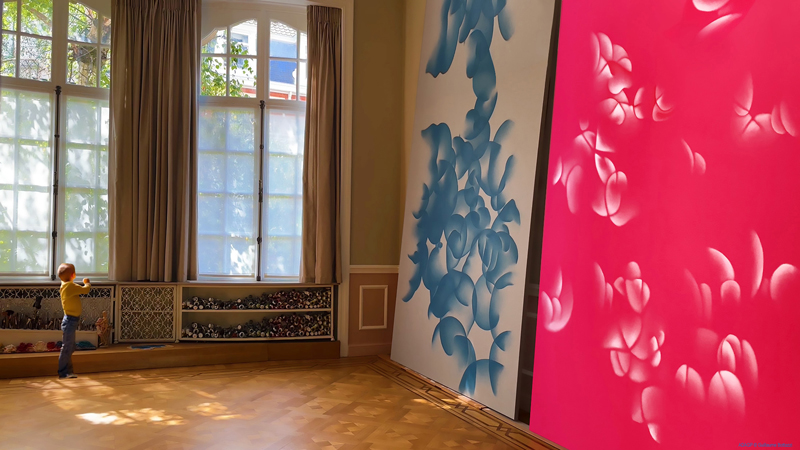
Disarming the Brain Through Form The starting point of Leder and Nadal’s analysis is the pervasive presence of curvature in Bottazzi’s work. This observation is far from incidental: human preference for curved contours is one of the most robust and widely replicated findings in experimental psychology. In two landmark studies published in Psychological Science (2006) and Neuropsychologia (2007), Moshe Bar and Maital Neta demonstrated that objects with curved contours are significantly preferred over angular ones, and that this preference is associated with reduced activity in the amygdala — the brain structure that plays a central role in the processing of fear and threat. Sharp angles signal biological danger; curves signal its absence. This finding was extended to architecture. In a neuroimaging study published in the Proceedings of the National Academy of Sciences (2013), an international team including Leder and Nadal presented participants with carefully selected images of modern interior spaces, systematically varying the curvature of architectural lines. Functional MRI revealed that curvilinear interiors elicit greater activation in the anterior cingulate cortex — a region associated with the emotional significance of objects and their rewarding qualities — and that participants’ beauty judgments were primarily driven by pleasure (Vartanian et al., 2013). Bottazzi deploys this mechanism at architectural scale. His murals, often monumental, transform rectilinear architectural surfaces — concrete facades, glass walls, hospital corridors, office partitions — into organic spaces governed by fluid lines. The anterior cingulate cortex is engaged; the amygdala is soothed. The effect occurs automatically, in all likelihood without the viewer being consciously aware of it — as Leder and Nadal note when they observe that these characteristics “automatically, probably unconsciously, elicit pleasure.”
3. Evanescent Forms:
Forcing Cognitive Activity, Modulating New Neurons A second strategy characteristic of Bottazzi is the technique of evanescent contours: his figures and color fields do not end in sharp edges, but dissolve progressively into the support, through a succession of gradients that fade gently away. This practice is directly informed by Eric Kandel’s research on the paintings of Mark Rothko. In his work Reductionism in Art and Brain Science (2012), Kandel observes that the deliberately undefined edges of Rothko’s forms compel the viewer’s cognitive activity: faced with a blurred contour, the brain cannot rely on low-level retinal information to automatically complete the form — it must activate top-down processes, draw on its own stored representations, and fill in the gaps itself. This sustained cognitive engagement is associated with synaptic reorganization: the brain that actively engages with an artwork modulates new neurons, forging new connections. Kandel speaks in this context of art’s capacity to participate in neuroplasticity. Bottazzi has integrated this principle into his practice deliberately. His evanescent forms are not decorative effects but devices of cognitive activation: they require the viewer to participate in the construction of the work, transforming passive contemplation into active engagement. Art that leaves zones incomplete is art that recruits the brain rather than saturating it.
4. Glazing and the Peak Shift Effect:
Dopamine and the Ventral Striatum The pictorial technique of glazing — translucent layers of paint superimposed to create depth, luminosity, and textural subtlety impossible to observe in nature — activates a third neurobiological mechanism, theorized by Ramachandran and Hirstein under the name of the peak shift or supernormal stimulation effect. In their foundational 1999 paper, the two researchers propose that art functions as a “supernormal stimulus”: just as a rat trained to distinguish a rectangle from a square will respond with increasing intensity to progressively elongated rectangles (far beyond the rewarded prototype), the human brain responds in an amplified fashion to visual stimuli that exaggerate or idealize the properties of perceived reality. Idealized figurative painting, the modeling of Raphael, the impossible depths of Dutch landscapes — all obey this principle. Light that does not exist in nature, depth more intense than any real depth, activates visual areas more powerfully than an ordinary stimulus. This “leap” in visual processing triggers a dopaminergic response in the ventral striatum — the brain’s center of motivation and reward anticipation. Dopamine is not merely the molecule of pleasure: as Salamone et al. demonstrated in Nature Reviews Neuroscience, it is the “starter” of action, enabling us to overcome obstacles and engage with the world. Salgado-Pineda et al. (National Library of Medicine) documented its role in the regulation of emotional perception. Research conducted at the CNRS by Naudé, Faure, and Delord has shown its importance in learning and memory consolidation — dopamine helps the brain select and retain the events worth remembering. Bottazzi’s glazes, by producing luminosity and depth that exist nowhere in nature, trigger precisely this response. This is not a surface effect: it is an activation of the dopaminergic system through a centuries-old pictorial technique, redeployed in light of contemporary neuroscience.
5. Implied Movement:
Engaging V5/MT+ and Amplifying Aesthetic Appreciation Bottazzi’s works do not move, yet they evoke movement: forms appear to flow, shift, and coil upon themselves. This characteristic engages a well-documented neurological mechanism. The visual area V5/MT+ (the middle temporal region) is specifically dedicated to processing motion in the visual field. Neuroimaging research has established that static images strongly evoking movement activate this region even in the complete absence of physical displacement — a phenomenon known as implied motion. The study by Massaro et al. (*PLoS ONE*, 2012), using eye-tracking, showed that artworks with high dynamic content — those whose figurative representations evoke instability or transition — are preferred over static works by non-specialist observers, and elicit more intense and prolonged visual exploration. This activation of the V5/MT+ region through implied motion is accompanied by an increase in aesthetic appreciation scores: the eye seeks to “complete” the initiated movement, generating sustained engagement with the work. The internal dynamism of Bottazzi’s paintings is therefore not merely a stylistic quality — it is a strategy of motor activation through visual means, one that sustains attention and deepens the aesthetic experience.
6. Abstraction:
Prolonged Engagement and the Default Mode Network Why paint abstractly in a practice oriented toward well-being? Professor Anjan Chatterjee of the University of Pennsylvania (*Explained: Art, Beauty & the Brain*) offers a counterintuitive answer: abstract art is more effective for sustained engagement. A figurative image — a pleasant landscape, a recognizable portrait — delivers immediately accessible information; the brain processes it quickly and moves on. Abstraction, by contrast, resists easy resolution: it invites a lasting relationship, a dialogue that evolves over time and varies with the viewer’s mood and state of mind. This observation finds neurological grounding in the research of Eric Kandel, Celia Durkin, and their colleagues (Durkin, Hartnett, Shohamy & Kandel, June 2020). Their study of viewer responses to abstract and figurative art, through the lens of construal level theory, shows that abstract art engages the default mode network more strongly — a set of brain regions that activate when we are not focused on an external task but are engaged in autobiographical memory, imagination, introspection, and future projection. This cognitive mode is associated with creative thinking, an enhanced capacity to step back from one’s own experience, and a degree of mental quietude. By choosing abstraction, Bottazzi opens a mental space that representational images cannot open: his works engage the imagination as much as the eyes, allowing each viewer to project their own inner world onto the offered forms and colors.
7. Beauty and the Caudate Nucleus:
Toward a Neuroaesthetics of Social Peace Zeki demonstrated that the recognition of visual beauty activates not only the orbitofrontal cortex — linked to reward — but also the caudate nucleus, a subcortical structure implicated in the reward and motivation circuit that is equally activated by romantic love and desire (*Inner Vision*, 1999). This convergence of beauty, love, and desire on a shared neurological substrate is not a metaphor: it is an anatomical fact. The emotional dispositions induced by these three states share a common biology — openness to others, a lowering of defenses, and an orientation toward affiliation rather than confrontation. This observation carries implications that extend beyond the individual. If an artwork judged beautiful places its viewers in dispositions similar to those of love, it creates — within the shared spaces where it is installed — a collective predisposition toward goodwill and connection. It is at this level that the social dimension of Bottazzi’s work acquires its full meaning: his in-situ pieces, installed in apartment lobbies, healthcare spaces, and public squares, act upon individuals who do not know one another, in spaces where cohabitation can readily become a source of tension. —
8. Oxytocin and the Reduction of Social Tension
Susan Magsamen and Ivy Ross, in Your Brain on Art (2023), highlight that art can function as a catalyst for empathy and trigger the release of oxytocin — the neuropeptide often called the “bonding hormone.” Oxytocin plays a documented role in inter-individual trust, the reduction of social phobia and generalized anxiety, and the recognition of faces and social signals (Rémy C. Martin-Du Pan, Swiss Medical Review). Research published in the National Library of Medicine (Gordon, Zagoory-Sharon, Leckman & Feldman) has clarified its role in human attachment behaviors, extending well beyond the maternal sphere. It is regarded as an “anti-stress” hormone, whose levels tend to vary inversely with those of cortisol and vasopressin — two biological markers of stress and depression. Art that is collectively perceived as beautiful, in a shared space, can activate this neurochemical cascade at the level of a group: it creates a shared object of attention, a common experience capable of triggering the social bonding responses associated with oxytocin. This is one of the reasons why the WHO, in its 2019 report on the role of the arts in public health (Fancourt & Finn), finds that artistic interventions in care settings offer a favorable cost-effectiveness ratio compared to certain pharmacological interventions — in large part because they act simultaneously on the social, behavioral, and biological dimensions of well-being.
9. Mirror Neurons and the Fight Against Loneliness
The activation of mirror neurons by art is a phenomenon documented by neuroscience. These neurons, discovered by Giacomo Rizzolatti and his team at the University of Parma in the 1990s, fire not only when we perform an action, but also when we observe someone else performing it. By analogy, contemplating a work of art — particularly one that evokes presence, gesture, or the movement of another being — can trigger an internal simulation of that presence. Neurologist Pierre Lemarquis, in his book L’Art qui guérit [The Healing Power of Art] (2020), argues that we do not look at a work of art the way we look at a decoration, but the way we meet a person: the work activates mirror neurons that attenuate the feeling of loneliness and isolation. This observation takes on particular weight in the context of hospital settings or residential facilities for the elderly, where social isolation is a recognized morbidity factor. A permanent artwork, in a care corridor or an apartment lobby, can exercise a presence that occupants gradually come to experience as familiar — with all the neurobiological effects that such familiarity entails.
10. Art In Situ as the Humanization of Space
The final strategy is perhaps the most coherent with the overall program: Bottazzi does not create paintings intended for gallery exhibition, but permanent works conceived for a specific site, integrated into its architecture, proportions, and light. This site-specificity (*in situ*) is not an incidental aesthetic choice — it is a neuroaesthetic decision. Our perception is holistic: we do not perceive a painting and a wall separately, an environment and its visual content as distinct. Place and artwork are mutually constructed in our experience. A Bottazzi work does not decorate a lobby — it redefines it, transforming it into a meaningful and habitable space. People who pass by this work daily gradually integrate it into their representation of the space; the work becomes an affective reference point, an identity landmark, a presence that humanizes a place that might otherwise be nothing more than a functional surface. The study by Mikuni, Leder et al. (2024, Wellbeing, Space and Society) measured precisely this effect on the streets of Vienna: passersby exposed to artistic interventions in urban spaces reported a significant reduction in their subjective sense of anxiety and stress, and evaluated their immediate environment more favorably.
11. Conclusion:
A Coherent Program, Biologically Grounded Effects The formal and technical strategies of Guillaume Bottazzi form a coherent program, organized around a central question: what must a work of art do in order to act positively on the brains of those who inhabit the same space? The elements of response we have identified — soothing curvature, evanescent forms, supernormal glazes, implied movement, engaging abstraction, beauty that generates dopamine and oxytocin, a presence that activates mirror neurons, integration into lived space — each constitute mechanisms whose neurobiological foundations are documented in the existing scientific literature. Critically, this article rests on a well-established epistemological principle: science does not need to re-prove what it has already proven. When the characteristics of Bottazzi’s works are the same as those documented to produce specific neurological effects — curved forms that quiet the amygdala, implied movement that engages V5/MT+, glazed luminosity that exceeds natural stimulation — the inference that these works produce those effects is scientifically valid. This is the logic of nomological-deductive reasoning, and it is the standard mode of inference in applied science. Furthermore, the field study by Mikuni, Leder et al. (2024) closes the loop between laboratory proof and real-world confirmation: artistic interventions in ordinary urban spaces measurably reduce anxiety and stress in real passersby under real conditions. This program represents a genuine paradigm shift in the conception of contemporary art. Where much of twentieth-century artistic production defined itself through rupture, disruption, or the deliberate unsettling of the gaze, Bottazzi’s approach renews a more ancient and universal conception: beauty as a common good, art as care, aesthetic experience as a biological resource. This is, in the framework proposed in this article, the defining character of an artistic practice that takes stock of the Anthropocene world — not to lament it, but to contribute positively to it.
References
Bottazzi, G. (Ed.), Leder, H., & Nadal, M. (2017/2026). Curved art in the real world: A psychological look at the art of Guillaume Bottazzi. Artist’s catalogue / University of Vienna, Institut für Psychologie. Bar, M. & Neta, M. (2006). Humans prefer curved visual objects. Psychological Science, 17(8), 645–648. Bar, M. & Neta, M. (2007). Visual elements of subjective preference modulate amygdala activation. Neuropsychologia, 45(10), 2191–2200. Chatterjee, A. (2014). The Aesthetic Brain: How We Evolved to Desire Beauty and Enjoy Art. Oxford University Press. Durkin, C., Hartnett, E., Shohamy, D. & Kandel, E. R. (2020). Objective evaluation of viewer response to abstract and figurative art according to construal level theory. Columbia University (June 2020). Fancourt, D. & Finn, S. (2019). What is the evidence on the role of the arts in improving health and well-being? A scoping review. WHO Regional Office for Europe. Gordon, I., Zagoory-Sharon, O., Leckman, J. F. & Feldman, R. (2010). Oxytocin and the development of parenting in humans. Biological Psychiatry. National Library of Medicine. Kandel, E. R. (2012). Reductionism in Art and Brain Science: Bridging the Two Cultures. Columbia University Press. Leder, H. & Nadal, M. (2014). Ten years of a model of aesthetic appreciation and aesthetic judgments: The aesthetic episode. British Journal of Psychology, 105(4), 443–464. Lemarquis, P. (2020). L’Art qui guérit [The Healing Power of Art]. Odile Jacob. Magsamen, S. & Ross, I. (2023). Your Brain on Art: How the Arts Transform Us. Random House. Martin-Du Pan, R. C. (2012). Role of oxytocin in social behavior, stress, and psychiatric disorders. Swiss Medical Review (*Revue Médicale Suisse*). Massaro, D., Savazzi, F., Di Dio, C., Freedberg, D., Gallese, V., Gilli, G., & Marchetti, A. (2012). When art moves the eyes: A behavioral and eye-tracking study. PLoS ONE, 7(5), e37285. Mikuni, J., Dehove, M., Dörrzapf, L., Moser, M. K., Resch, B., Böhm, P., Prager, K., Podolin, N., Oberzaucher, E. & Leder, H. (2024). Art in the city reduces the feeling of anxiety, stress, and negative mood. Wellbeing, Space and Society, 7, art. 100215. Naudé, J., Faure, P. & Delord, B. (n.d.). From learning to action: Dopamine reveals our hidden learning. CNRS Biology. Ramachandran, V. S. & Hirstein, W. (1999). The science of art: A neurological theory of aesthetic experience. Journal of Consciousness Studies, 6(6–7), 15–51. Salamone, J. D., Correa, M., Farrar, A. & Mingote, S. M. (2007). Effort-related functions of nucleus accumbens dopamine and associated forebrain circuits. Psychopharmacology, 191, 461–482. Salgado-Pineda, P., Delaveau, P., Blin, O. & Nieoullon, A. (2005). Dopaminergic contribution to the regulation of emotional perception. Clinical Neuropharmacology, 28(5), 228–237. National Library of Medicine. Vartanian, O., Navarrete, G., Chatterjee, A., Brorson Fich, L., Leder, H., Modroño, C., Nadal, M., Rostrup, N. & Skov, M. (2013). Impact of contour on aesthetic judgments and approach-avoidance decisions in architecture. PNAS, 110(Suppl. 2), 10446–10453. Zeki, S. (1999). Inner Vision: An Exploration of Art and the Brain. Oxford University Press.